
TKeeper
Open-source cryptographic identity and policy layer for AI agents, keys, and machine workflows
Gallery
About TKeeper
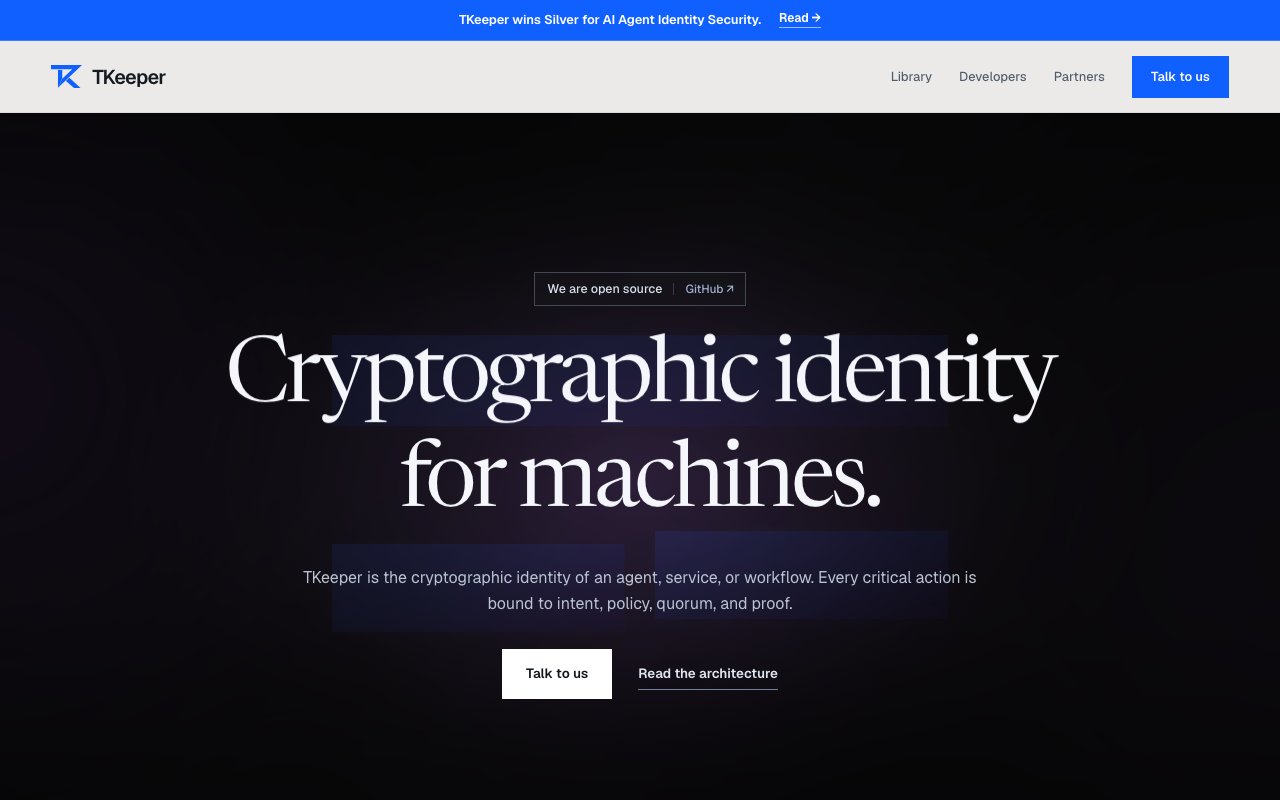
TKeeper is an open-source, self-hosted authority layer that gives machines a cryptographic identity whose use is constrained by explicit policy. The problem it targets is that AI agents, services, and automated workflows increasingly hold keys that can sign transactions, issue certificates, or run privileged commands, and a single compromised process or a single stolen key is enough to lose everything. TKeeper sits between a proposed action and its backend effect, binding every machine action to intent, policy, quorum, and proof before it executes.
The core move is that no single point holds full signing power. In threshold mode, TKeeper spreads a signing identity across t-of-n peers using multi-party computation, so producing a signature requires a quorum of independent nodes to cooperate. Compromise one peer and you still can't sign. The threshold layer is built to tolerate Byzantine behavior, peers that fail, withhold messages, or send invalid cryptographic contributions, and key refresh lets a set of threshold peers replace compromised shares while preserving the public key, so rotation doesn't break everything downstream. For simpler deployments there's also a single-node mono mode, which makes a local single-node setup the natural entry point before scaling out.
Policy is where the governance happens. Agent requests are converted into typed intents that get evaluated against explicit authorities and policy before anything is signed. That structure is also TKeeper's answer to prompt injection, an agent that's been talked into doing something malicious still can't exceed its typed intent, its least-privilege scope, and the approvals its policy demands. Optional four-eye control requires multiple independent human approvers to review and sign the exact action an agent proposed, and everything that happens lands in a verifiable audit log, so you get proof of what was authorized and what actually ran.
The integration surface is broad for a young project. On the signing side it supports EVM chains, Bitcoin, X.509 certificate operations, and arbitrary custom signing, which covers crypto operations, PKI, and infrastructure automation with one system. Cryptographically it spans classical elliptic-curve schemes, ECIES for encryption, and post-quantum ML-DSA, so identities can be stood up on post-quantum signatures where that matters. Developers get an OpenAPI-documented HTTP interface and a Java SDK, and operators get an optional control plane UI for governance operations plus the usual key lifecycle, creation, rotation, refresh, and recovery.
The intended audience is teams whose machines already hold dangerous capabilities. That means platform and security engineers securing AI agent tool calls, crypto teams that want treasury or protocol keys behind a quorum, operators of certificate authorities and PKI, and anyone whose automation can touch critical infrastructure. If you've been uncomfortable handing an autonomous agent a raw private key or an all-powerful API token, this is the class of problem TKeeper exists for. The project also maintains a fundamentals library on the site that walks through the underlying ideas, agent identity, intent-based authorization, signing without key exposure, and Byzantine fault tolerance, which is worth reading even if you never deploy the software, because it lays out a coherent model for what machine identity should mean once agents act on your behalf.
What makes it different from a standard secrets manager or KMS is the combination of distributed authority and intent-level governance. A vault stores a key and hands it to whoever authenticates. TKeeper never exposes the key at all, agents request signatures through a governed identity, the request is checked as a typed intent against policy, a quorum produces the signature, and the audit trail proves the whole chain. It's closer to a programmable, self-hosted HSM with built-in approval workflows than to a password store, and the same identity model stretches across payments, deployments, and certificates instead of needing a separate control system for each.
Access is fully open source. You self-host it, single node to start, threshold peers when you need distributed trust, and there's no pricing page because there's nothing to buy. The code lives on GitHub under tkeeper-org, docs cover deployment, configuration, initialization, and unseal, and the team is reachable at labs@tkeeper.org. For a security tool, being able to read every line before you trust it with your keys is exactly the right posture.
Key Features
- Threshold MPC signing across t-of-n peers
- Typed intent and policy evaluation before execution
- Four-eye multi-approver controls
- Verifiable audit logging
- Post-quantum ML-DSA alongside classical ECC
- EVM, Bitcoin, X.509, and custom signing
Pros & Cons
What we like
- No single node ever holds full signing power
- Fully open source and self-hosted, so keys never leave your control
- Policy layer doubles as a prompt-injection defense for agent tool calls
- Key refresh replaces compromised shares without changing the public key
Room for improvement
- Requires real technical setup and operational commitment
- Threshold deployments mean running multiple peers yourself
- Young project with a small community
- Java is the only explicitly documented SDK so far
Frequently Asked Questions
What is TKeeper?
Is TKeeper free?
How does TKeeper protect against a stolen key?
Who is TKeeper for?
Best For
Featured in
Alternatives to TKeeper

1Password
Password and secrets manager for individuals, families, and developer teams with strong CLI and SSH agent support.
Clerk
Drop-in authentication and user management for modern apps

Tailscale
WireGuard-based mesh VPN that connects your devices, servers, and cloud resources into one private network in minutes.

BackPedal
UK bike theft protection that sends recovery agents after your stolen bike
Reviews (0)
Badge builder
Add TKeeper to your website
Choose a badge style and size, preview it here, then copy the generated HTML. Badge images are self-contained SVGs and do not require an external script.

<a href="https://toolindex.net/tools/tkeeper?ref=badge" target="_blank" rel="noopener">
  <img src="https://toolindex.net/badge/tkeeper/medium.svg" alt="TKeeper - Listed on Tool Index" width="180" height="50" />
</a>How to use the badge
- 1. Pick the style, size, and theme that fit your layout.
- 2. Copy the generated HTML from the code block.
- 3. Paste it into your footer, homepage, or press page.
Standard badge available
The standard listing badge is available now. Score and circle badges are limited to tools currently ranked in the top 10 of a category.
Badge clicks return visitors to this profile with a referral tag so the source remains identifiable.
Related Tools
Clerk
Drop-in authentication and user management for modern apps

DomeSOC
Autonomous SOC that grades every AI claim against evidence before it reaches an analyst
Reel
Forensic evidence capture for regulated Kubernetes, plus a free open-source VEX hub

HeimWall
Menu bar app that catches secrets and PII before you paste them into AI coding tools
Work on TKeeper? Request listing access or correction