
Fiveonefour
Test how AI coding agents discover and interact with your developer tools
Gallery
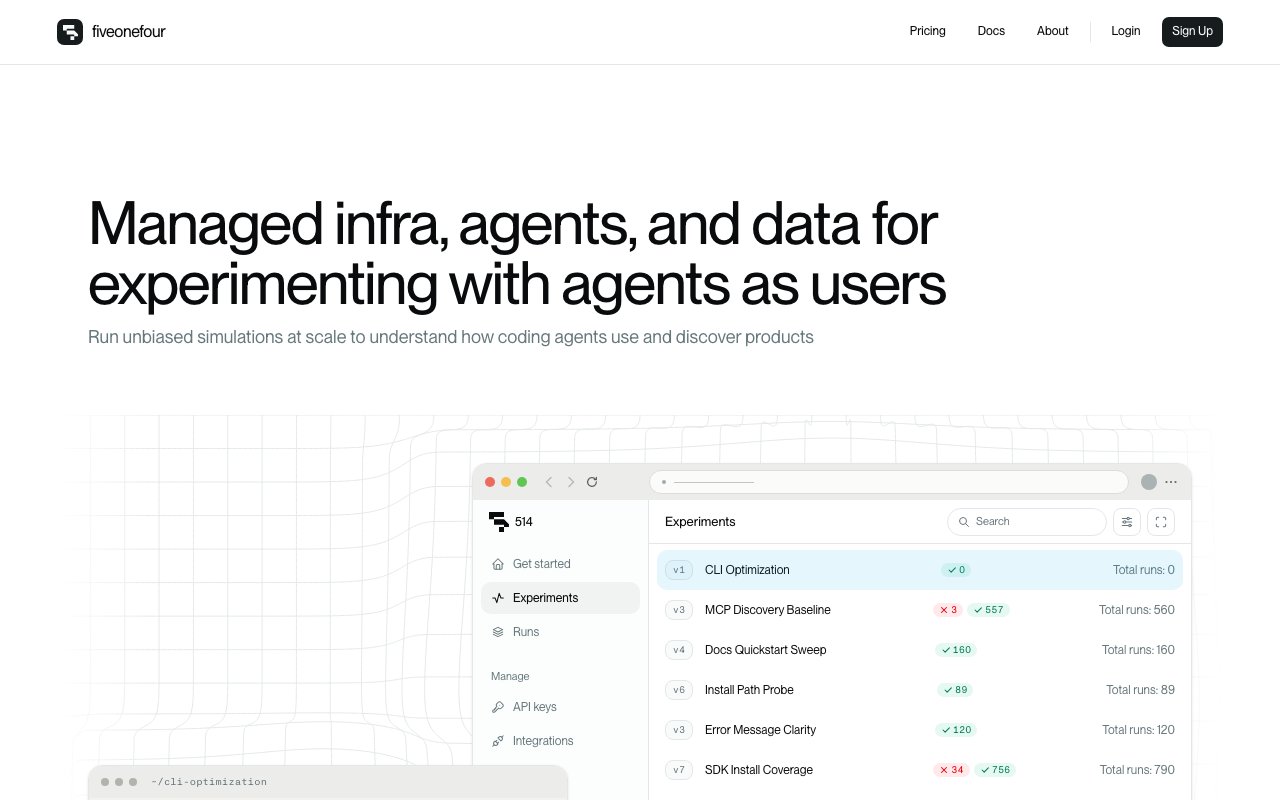
About Fiveonefour
Fiveonefour is an experimentation platform for understanding how AI coding agents interact with your product. If you build CLIs, SDKs, APIs, MCP servers, or documentation, you probably want to know whether agents like Claude Code, Codex, or Cursor can actually use what you ship. Fiveonefour lets you run controlled experiments that simulate agent users at scale, then surfaces the data you need to identify friction and prove what works. The pitch is direct: autonomy you cannot measure is autonomy you cannot ship. If your customers are increasingly working through AI coding assistants rather than reading docs and clicking buttons, you need to understand how those agents experience your product before problems reach production.
The core workflow has four stages that take you from hypothesis to evidence. First, you design experiments that test variants across prompts, agents, models, products, and environments using a YAML configuration schema that defines exactly what combinations to try. Second, you run those experiments in isolated sandboxes where each agent starts fresh with no prior conversation history, ensuring the results are unbiased and reproducible. Third, you score the results using custom bash scripts that measure agent activities and sandbox output against your success criteria. Fourth, you analyze the data the platform captures, which includes agent transcripts, OTEL logs and errors, command execution history, test outcomes, token usage, cost, and wall clock time. All of this is versioned and warehoused for querying through the CLI or an MCP, so you can build dashboards, track trends over time, and integrate findings into your development workflow.
Sandboxes spin up on demand, either locally on your machine for free or in the cloud via AX Cloud for larger sample sizes that would overwhelm a single laptop. Each run is isolated so one agent's behavior does not bleed into another's results. When a run finishes, the full sandbox end state including file system and memory is retained, meaning you can retest or inspect without repeating the entire experiment or regenerating expensive tokens. Secure secret injection handles credentials for each sandbox without exposing them in logs or config files, and test execution happens in separate snapshot based sandboxes to prevent agents from cheating by reading the expected answers ahead of time.
The platform supports Claude Code, Codex, and Cursor as first class managed agents that work out of the box with no configuration required. You can also bring your own API keys and route model calls through the Fiveonefour gateway if you prefer to use your existing accounts, or use their managed access at market prices with short lived, run scoped tokens that expire after each experiment. Per model controls let you adjust effort settings and context windows to simulate different agent configurations. Data is automatically normalized across agent harnesses so comparisons are consistent regardless of which agent ran the task, making it easy to ask questions like whether Claude outperforms Codex on a particular workflow.
Common use cases include discovering onboarding bottlenecks in your CLI or SDK, validating that core user flows actually work for agents, comparing interface variants like documentation versus API versus MCP tools to see which surface agents prefer, and running competitive analysis against similar products to understand where you stand. You can even use results as product marketing evidence, showing prospective customers how well agents perform with your tooling and backing up claims with reproducible data. The platform is built for measuring agent experience before it reaches production rather than waiting for bug reports from confused users who tried to use their AI assistant with your tool.
Fiveonefour integrates into development workflows through pull request annotations and CI gating. Experiment summaries land on PRs before merge so teams can review agent experience changes alongside code changes. You can treat agent task success like any other CI check, blocking deploys when a change causes regressions in how well agents can use your product. Results are accessible via the CLI and MCP, so you can pipe data into your own analysis pipelines, dashboards, or alerting systems.
The company started in September 2023 as data infrastructure for human engineers. By January 2025, agents had become the majority of users interacting with developer products, and the team pivoted to focus on that shift. October 2025 saw the internal optimization platform launch, and AX Cloud went public in July 2026. Notable customers include Mux, which reported a thirty four percent reduction in tool call failures after using the platform to identify and fix agent friction, along with MongoDB, Dosu, Taubyte, and Gentle Weapons. Pricing is referenced on the site but not displayed publicly, suggesting a contact or demo based model rather than self serve checkout. The audience is development teams building tools for other developers, especially those whose users increasingly work through coding agents rather than clicking around a UI.
Key Features
- Isolated sandbox experiments at scale
- Managed agents for Claude Code, Codex, and Cursor
- Transcript and system activity capture
- PR integration with result annotations
- CI gating on agent success metrics
- Custom test scoring and analysis
Pros & Cons
What we like
- Lets you measure agent experience before shipping
- Isolated sandboxes ensure unbiased, repeatable results
- Supports multiple agents and bring your own keys
- Integrates into PRs and CI for workflow gating
Room for improvement
- Pricing not public, requires contact
- Narrow focus on agent interaction testing only
- Requires familiarity with CLI and experiment design
- Younger platform with a smaller community
Frequently Asked Questions
What is Fiveonefour?
Which agents does Fiveonefour support?
Is Fiveonefour free?
Who is Fiveonefour for?
Best For
Featured in
Alternatives to Fiveonefour

Playwright
Microsofts open-source end-to-end browser testing framework for Chromium, Firefox, and WebKit with one API.

Selenium Boot
Java testing framework that brings Spring Boot conventions and Playwright APIs to Selenium

Buildkite
Hybrid CI/CD where the control plane is hosted but the build agents run on your own infrastructure.

Storybook
Open-source workshop for building UI components in isolation. Preview, document, and test them outside the app.
Reviews (0)
Badge builder
Add Fiveonefour to your website
Choose a badge style and size, preview it here, then copy the generated HTML. Badge images are self-contained SVGs and do not require an external script.

<a href="https://toolindex.net/tools/fiveonefour?ref=badge" target="_blank" rel="noopener">
  <img src="https://toolindex.net/badge/fiveonefour/medium.svg" alt="Fiveonefour - Listed on Tool Index" width="180" height="50" />
</a>How to use the badge
- 1. Pick the style, size, and theme that fit your layout.
- 2. Copy the generated HTML from the code block.
- 3. Paste it into your footer, homepage, or press page.
Standard badge available
The standard listing badge is available now. Score and circle badges are limited to tools currently ranked in the top 10 of a category.
Badge clicks return visitors to this profile with a referral tag so the source remains identifiable.
Related Tools

DeviceKit
Free Screen & Device Tests Online | Private Browser Diagnostics

Chromatic
Visual regression testing and review platform built by the Storybook team, with cloud-rendered snapshots and PR integration.
Playwright
Microsofts open-source end-to-end browser testing framework for Chromium, Firefox, and WebKit with one API.

Tests.ws
WebSocket testing tools, protocol guides, and a Chrome extension for developers
Work on Fiveonefour? Request listing access or correction