Jac
Full stack programming language with native AI integration, graph data, and single binary deployment
Gallery
About Jac
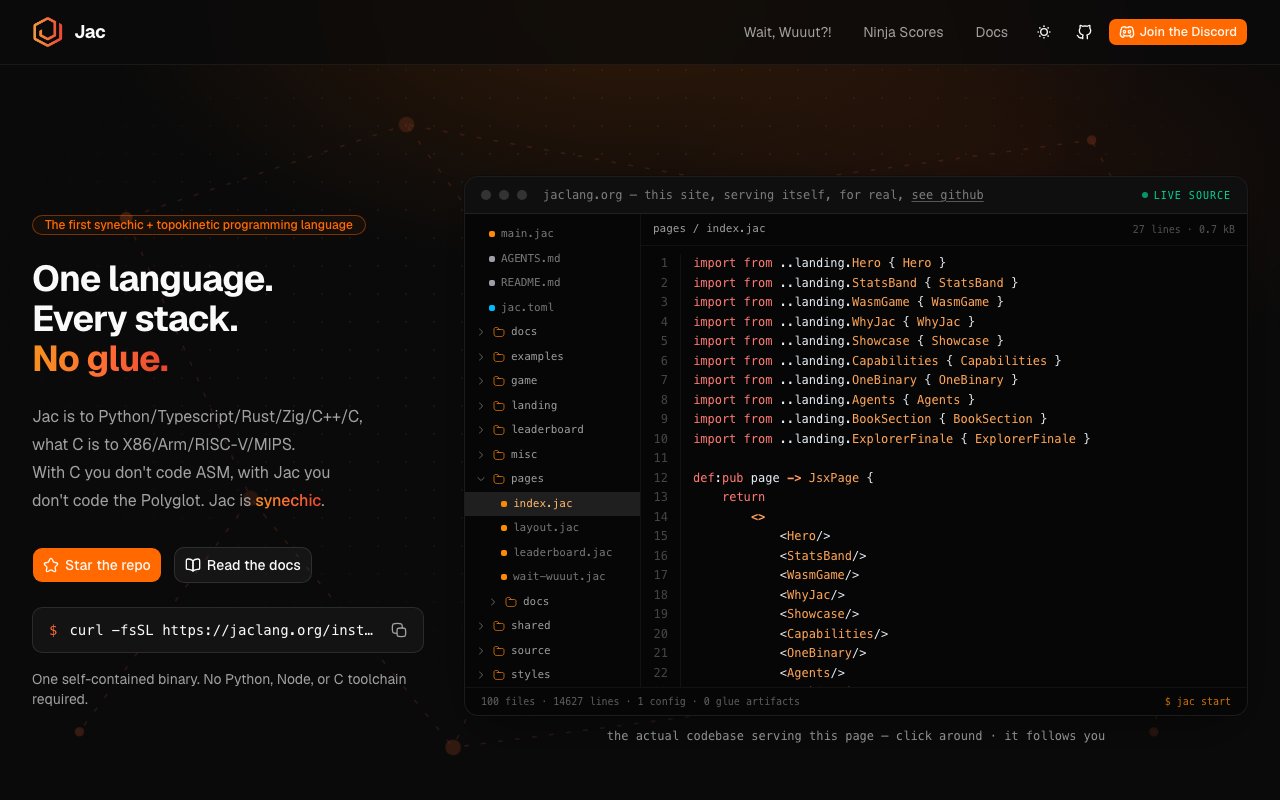
Jac is a programming language that tries to collapse the modern development stack into one coherent thing. Instead of writing Python for the backend, JavaScript for the frontend, and YAML for deployment, you write Jac and the compiler handles the rest. It outputs Python bytecode, JavaScript, or native machine code depending on what you're targeting, and every library from PyPI, npm, and native C ecosystems works directly without interop wrappers.
The language looks like Python and feels familiar if you've written Python, but it adds three ideas that change how you structure programs. First, meaning types turn large language models into language constructs. Instead of writing prompts manually, you annotate code with semantic meaning and the compiler generates optimized prompts automatically. That moves AI from an external API you call into something the language understands natively. Second, object spatial programming introduces nodes, edges, and walkers as core constructs. You model data as a graph and write computation that traverses it, which fits naturally for applications where relationships matter as much as records. Third, scale invariance means the same code runs unchanged in a terminal or across a distributed cluster. Deployment happens with a flag rather than a rewrite.
The practical effect is less glue code. Serializers, API routes, database bindings, and deployment manifests that normally require separate files and frameworks get generated by the compiler. You define a node, give it fields, and the runtime handles persistence. You start a service, and it provisions Kubernetes infrastructure automatically. The tradeoff is that you're committing to a new language and its opinions, but for projects that would otherwise span multiple languages and a lot of boilerplate, the reduction in surface area is significant.
Installation runs through a shell script that downloads a self contained binary for macOS or Linux. Windows support requires WSL for now. The project is MIT licensed and maintained by Jaseci Labs with an active community and regular releases. Documentation lives at docs.jaseci.org and covers the language tour, quick reference, and integration guides.
Jac targets developers building AI native applications who want to ship faster by working in one language end to end. If you're tired of context switching between frontend, backend, infrastructure, and prompt engineering, and you're willing to learn a new syntax to consolidate all of that, Jac offers a genuinely different approach to full stack development.
Key Features
- Compiles to Python bytecode, JavaScript, and native
- Native LLM integration with meaning types
- Graph based object spatial programming model
- Scale invariant code from local to cluster
- Direct PyPI, npm, and C library access
- One command Kubernetes deployment
Pros & Cons
What we like
- Eliminates glue code between frontend, backend, and infra
- AI prompts generate automatically from code semantics
- Single binary toolchain replaces multiple runtimes
- MIT licensed with active community and releases
Room for improvement
- Requires learning a new language and its paradigms
- Windows support needs WSL, no native installer
- Smaller ecosystem than established languages
- Graph programming model has a learning curve
Frequently Asked Questions
What is Jac?
Is Jac free?
Who is Jac for?
How does Jac handle AI integration?
Best For
Featured in
Alternatives to Jac
View allCursor
VS Code fork built around an AI pair-programmer

Sanity
Composable content platform with a customizable studio, real-time collaboration, and a queryable structured content backend.

PostHog
All-in-one product analytics, feature flags, and session replay
Cloudflare Pages
Free Jamstack hosting on Cloudflares edge with unlimited bandwidth and tight integration with Workers.
Reviews (0)
Badge builder
Add Jac to your website
Choose a badge style and size, preview it here, then copy the generated HTML. Badge images are self-contained SVGs and do not require an external script.

<a href="https://toolindex.net/tools/jac?ref=badge" target="_blank" rel="noopener">
  <img src="https://toolindex.net/badge/jac/medium.svg" alt="Jac - Listed on Tool Index" width="180" height="50" />
</a>How to use the badge
- 1. Pick the style, size, and theme that fit your layout.
- 2. Copy the generated HTML from the code block.
- 3. Paste it into your footer, homepage, or press page.
Standard badge available
The standard listing badge is available now. Score and circle badges are limited to tools currently ranked in the top 10 of a category.
Badge clicks return visitors to this profile with a referral tag so the source remains identifiable.
Related Tools

Kevin Gabeci
Solo developer building web apps, cozy browser games, and AI creator toolkits.

Warp
The modern terminal reimagined with AI and collaboration

Bolt.new
Prompt-to-deployed full-stack app inside the browser

Supabase
The open source Firebase alternative
Work on Jac? Request listing access or correction