
Gallery
About Oqoqo
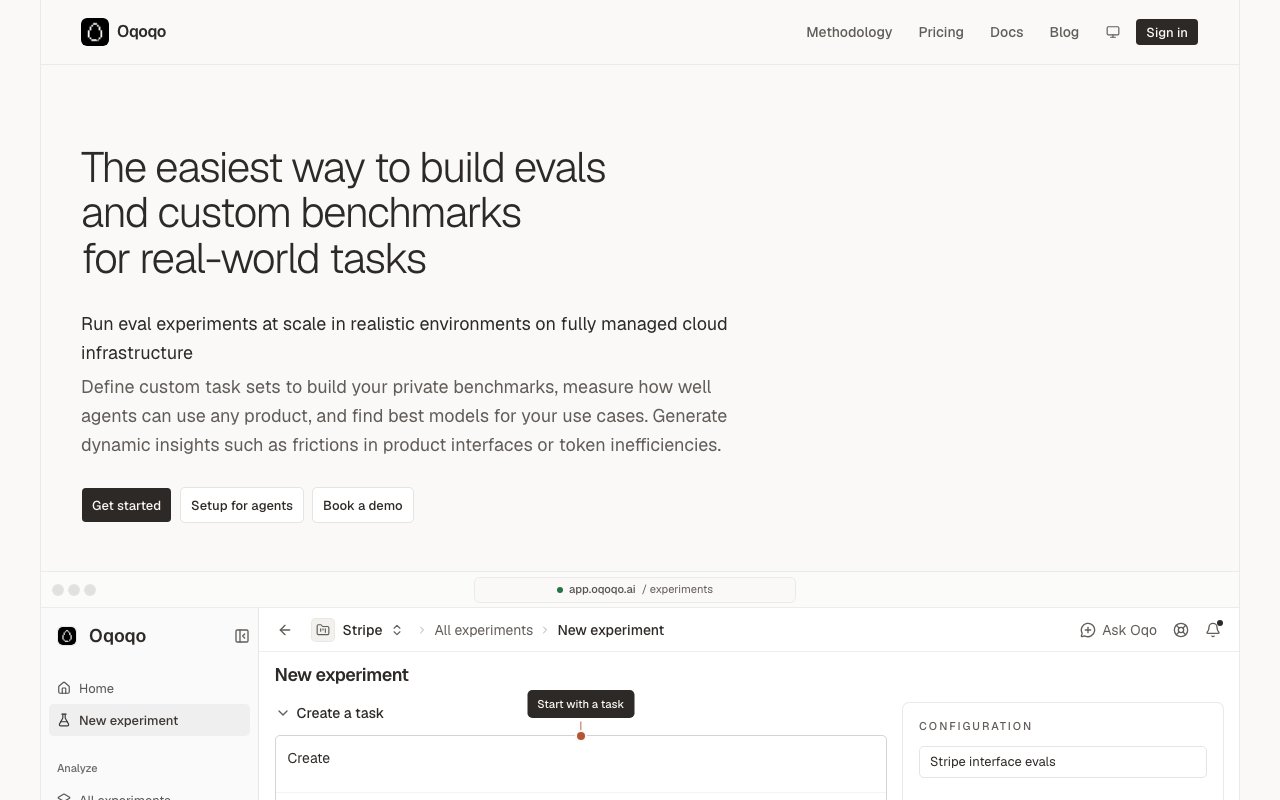
Oqoqo is an evaluation platform that lets you run AI agents against real products and measure how well they perform on actual tasks. Instead of relying on synthetic benchmarks that may not reflect real world usage patterns, you can point any agent at your own CLI tool, MCP server, SDK, or API and see exactly where it succeeds, fails, or gets stuck. The output is a complete trajectory showing every tool call, command, retry, reasoning step, and discovery loop the agent went through before either hitting its result or giving up. If you're building tools that AI agents will use, this gives you empirical evidence of what works and what doesn't rather than guessing based on capability scores from academic benchmarks.
The problem it solves is straightforward. Benchmarks like MMLU or HumanEval tell you how a model scores on standardized tests, but they don't tell you whether that model can actually navigate your product, find the right endpoint, parse your error messages, and complete a task successfully. If you're building MCP servers, developer tools, APIs, or any interface that AI agents might interact with, you need to know whether Codex, Claude Code, Cursor, GitHub Copilot, or any other harness can use what you've built. Oqoqo gives you that answer by running the task in an isolated sandbox, capturing everything the agent does along the way, and evaluating the final result against your own success criteria.
The infrastructure spins up isolated sandboxes for each run so one experiment doesn't contaminate another. It executes the tasks you've defined, provides the agent with the project state and tools it needs, and catalogs every single step from start to finish. When the run completes, you see token consumption, cost breakdown, pass or fail verdicts, and the written reasoning behind each judgment call. Because each run includes consistent project state, context injection, and tool availability, comparisons across models and agent harnesses stay fair. You can run the same task against Claude Code and then against Cursor, and see which one passed, which one burned more tokens, and at what point each one got stuck or gave up.
The primary audience is teams building agent facing surfaces. If you're shipping an MCP server, a CLI with natural language capabilities, an SDK that agents will call, or an API that needs to be discoverable without human guidance, Oqoqo lets you test whether AI agents can actually use it before your users try and fail. It also fits teams running regression tests on agent interfaces after shipping changes. Instead of waiting for bug reports from frustrated users who tried to automate something and couldn't figure out why the agent kept calling the wrong function, you catch those friction points before release. The feedback loop is faster than manual QA and more realistic than unit tests that don't model actual agent behavior.
What sets Oqoqo apart from other eval frameworks is the emphasis on real products over toy benchmarks and puzzle solving tasks. You're not measuring whether a model can pass a coding challenge in a vacuum or answer trivia correctly. You're measuring whether it can find the right endpoint in your documentation, call the right function with the right parameters, handle edge cases gracefully, and actually complete a workflow that matters to your users. The rubrics you write in plain language stay versioned across experiments, so runs from last month remain comparable to runs today even as your product evolves. That versioning also makes it possible to track regressions over time when you update your tooling or switch to a different agent provider.
Custom rubrics are written in plain language rather than code, which lowers the bar for defining what success looks like. You describe the expected outcome, the platform runs the agent, and the evaluation system determines whether the result matches what you asked for. If the agent took a weird path but still got the right answer, that shows up in the trajectory. If it got stuck in a loop retrying the same failed call, that shows up too. The level of detail is granular enough that you can debug agent behavior without having to reproduce it manually.
Access is free to try. You can run experiments on the platform and start seeing results without payment upfront. Pricing for heavier usage, team collaboration features, and enterprise support isn't published directly on the site, so you'd need to reach out if you plan to scale beyond the free tier or need SLA backed availability. For solo developers and small teams testing a handful of agent integrations, the free tier is likely enough to validate whether your tooling works as expected.
Key Features
- Isolated sandbox execution for each task
- Full trajectory capture of agent actions
- Custom rubrics in plain language
- Token consumption and cost tracking
- Multi-agent comparison on same tasks
- Versioned experiments for fair comparisons
Pros & Cons
What we like
- Tests agents against real products rather than synthetic benchmarks
- Shows exactly where and why an agent failed
- Supports any agent harness including Claude Code, Cursor, Codex
- Free tier available to start testing immediately
Room for improvement
- Pricing for heavier usage not published on site
- Newer product with a smaller community
- Requires defining your own tasks and rubrics
- Focused on agent tooling, not general LLM evaluation
Frequently Asked Questions
What is Oqoqo?
Is Oqoqo free?
Who is Oqoqo for?
What agents does Oqoqo support?
Best For
Featured in
Alternatives to Oqoqo

Playwright
Microsofts open-source end-to-end browser testing framework for Chromium, Firefox, and WebKit with one API.
Selenium Boot
Java testing framework that brings Spring Boot conventions and Playwright APIs to Selenium
Buildkite
Hybrid CI/CD where the control plane is hosted but the build agents run on your own infrastructure.

Storybook
Open-source workshop for building UI components in isolation. Preview, document, and test them outside the app.
Reviews (0)
Badge builder
Add Oqoqo to your website
Choose a badge style and size, preview it here, then copy the generated HTML. Badge images are self-contained SVGs and do not require an external script.

<a href="https://toolindex.net/tools/oqoqo?ref=badge" target="_blank" rel="noopener">
  <img src="https://toolindex.net/badge/oqoqo/medium.svg" alt="Oqoqo - Listed on Tool Index" width="180" height="50" />
</a>How to use the badge
- 1. Pick the style, size, and theme that fit your layout.
- 2. Copy the generated HTML from the code block.
- 3. Paste it into your footer, homepage, or press page.
Standard badge available
The standard listing badge is available now. Score and circle badges are limited to tools currently ranked in the top 10 of a category.
Badge clicks return visitors to this profile with a referral tag so the source remains identifiable.
Related Tools
DeviceKit
Free Screen & Device Tests Online | Private Browser Diagnostics

Chromatic
Visual regression testing and review platform built by the Storybook team, with cloud-rendered snapshots and PR integration.
Playwright
Microsofts open-source end-to-end browser testing framework for Chromium, Firefox, and WebKit with one API.

Tests.ws
WebSocket testing tools, protocol guides, and a Chrome extension for developers
Work on Oqoqo? Request listing access or correction