
Port Zero
Stable local domains for dev ports, eliminating conflicts and enabling cloud tunnels
Gallery
About Port Zero
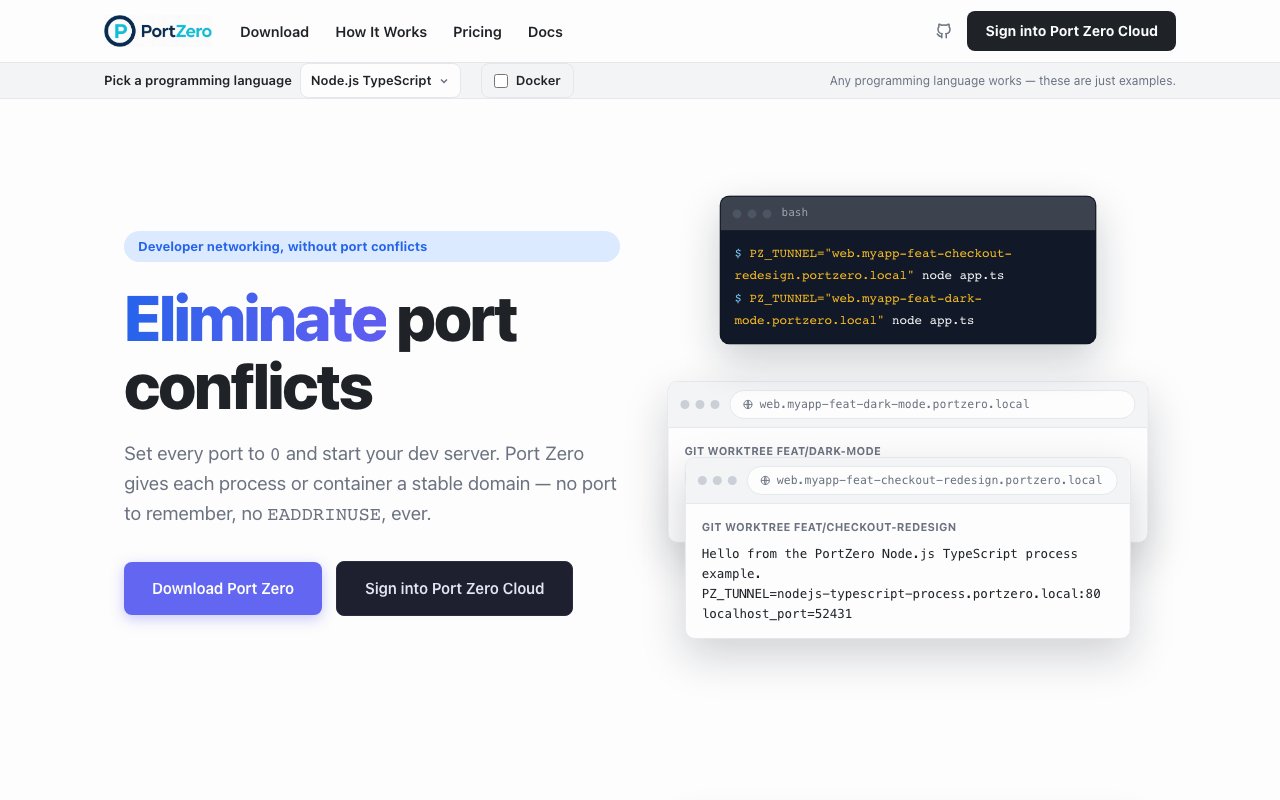
Port Zero solves a problem every developer knows but rarely thinks about until it bites them. You start a server, it grabs a port, and later another process wants the same one. The error message appears, EADDRINUSE, and now you're hunting through terminals or rebooting containers. Port Zero sidesteps all of that by letting you set every port to zero and giving each process a stable domain instead.
The way it works is straightforward. You configure your dev server with an environment variable that assigns it a domain like web.myapp.portzero.local. The tool handles port allocation automatically, and you access your service through the domain rather than remembering numbers. That domain stays consistent across restarts, which means bookmarks, OAuth redirects, and webhook URLs don't break every time something changes.
For local development this runs free and stays entirely on your machine. Tunnels resolve without network calls. Where it gets more interesting is the cloud tunnel feature, which gives you a public HTTPS URL to share your local app with a phone, tablet, or someone else reviewing your work. That's useful for webhook testing, mobile debugging, or quick demos without deploying to staging.
The tool supports macOS, Linux, and Windows through installers and a CLI. There's a team layer on top for organizations that want governance, approval workflows, and shared tunnel access without everyone managing their own credentials. An AI agent integration via Model Context Protocol is also available for automation scenarios.
Port Zero is open source under the GPL v3 license for the local tunnel functionality. Cloud tunnels and team features move into paid territory. The Professional tier runs forty nine dollars a month for unlimited cloud tunnels, and the Team plan at one hundred forty nine dollars a month adds multiple members and approval workflows. Enterprise pricing is custom.
If you've ever juggled multiple git worktrees, run several microservices locally, or burned time on port collisions across containers, this is aimed at that friction. It's a small tool that targets a small but persistent annoyance, and the free local tier means you can test whether it fits your workflow before paying for cloud features. The value scales with how often you share local work externally or coordinate across a team.
Key Features
- Automatic port allocation via environment variable
- Stable local domains for dev processes
- Free local tunnels under GPL v3
- Public HTTPS cloud tunnels for sharing
- Team governance and approval workflows
- AI agent integration via MCP
Pros & Cons
What we like
- Eliminates port conflict errors without manual management
- Local domains stay consistent across restarts
- Free tier covers all local tunnel functionality
- Open source core with transparent licensing
Room for improvement
- Cloud tunnels require a paid subscription
- Adds a layer of indirection to local networking
- Younger product with a smaller community
- Team features priced for organizations, not individuals
Frequently Asked Questions
What is Port Zero?
Is Port Zero free?
Who is Port Zero for?
What platforms does Port Zero support?
Best For
Featured in
Alternatives to Port Zero
View allCursor
VS Code fork built around an AI pair-programmer

Sanity
Composable content platform with a customizable studio, real-time collaboration, and a queryable structured content backend.

PostHog
All-in-one product analytics, feature flags, and session replay
Cloudflare Pages
Free Jamstack hosting on Cloudflares edge with unlimited bandwidth and tight integration with Workers.
Reviews (0)
Badge builder
Add Port Zero to your website
Choose a badge style and size, preview it here, then copy the generated HTML. Badge images are self-contained SVGs and do not require an external script.

<a href="https://toolindex.net/tools/port-zero?ref=badge" target="_blank" rel="noopener">
  <img src="https://toolindex.net/badge/port-zero/medium.svg" alt="Port Zero - Listed on Tool Index" width="180" height="50" />
</a>How to use the badge
- 1. Pick the style, size, and theme that fit your layout.
- 2. Copy the generated HTML from the code block.
- 3. Paste it into your footer, homepage, or press page.
Standard badge available
The standard listing badge is available now. Score and circle badges are limited to tools currently ranked in the top 10 of a category.
Badge clicks return visitors to this profile with a referral tag so the source remains identifiable.
Related Tools

Kevin Gabeci
Solo developer building web apps, cozy browser games, and AI creator toolkits.

Warp
The modern terminal reimagined with AI and collaboration

Bolt.new
Prompt-to-deployed full-stack app inside the browser

Supabase
The open source Firebase alternative
Work on Port Zero? Request listing access or correction