Punter.js
Single-file JavaScript game engine designed to teach programming through browser games
Gallery
About Punter.js
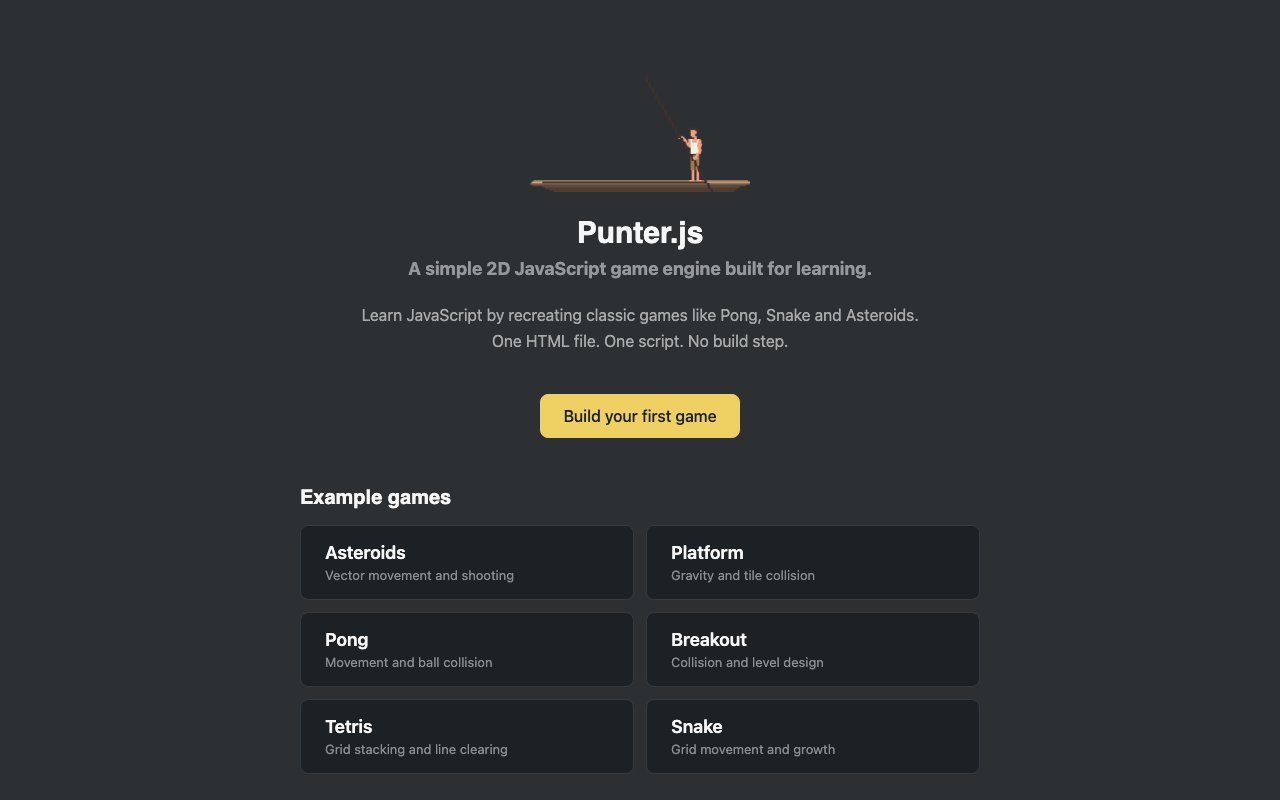
Punter.js is a minimal 2D game engine built to help new developers learn JavaScript by making browser games. It ships as a single file with no dependencies and no build step, so you can drop it into an HTML page and start coding immediately. The project comes from Orca Scan, a company that builds barcode scanning software, and grew out of their internal efforts to make programming education more accessible.
The pitch is simplicity over power. Modern game engines are complex, with asset pipelines, physics systems, and tooling that can overwhelm a beginner before they write a single line of game logic. Punter strips that away. You get a canvas, a game loop, and enough structure to build classic games without wrestling with configuration.
The repository includes working examples of Asteroids, Pong, Breakout, Tetris, Snake, and a platformer. Each demonstrates a core mechanic, vector movement, collision detection, gravity, grid systems, so you can study how the pieces fit together and modify them to learn. The examples are playable on the website, and the code is open to inspect.
It runs in the browser with no server required. You write your game in plain JavaScript, open the HTML file, and it runs. That makes it suitable for classrooms, workshops, or self-taught learners who do not want to install tooling before they can experiment.
The engine is open source and hosted on GitHub. Licensing details are in the repository. There is no pricing because there is nothing to pay for. The audience is students, hobbyists, and educators who want a zero-friction way to teach or learn game development fundamentals in JavaScript.
Where it fits in the landscape is as a teaching tool rather than a production engine. You would not ship a commercial game on Punter, but you might use it to teach someone how game loops work, how to handle input, or how to detect when two rectangles overlap. Once they understand those concepts, they can graduate to heavier engines with that foundation in place.
Documentation lives on GitHub alongside the source. The maintainers are the Orca Scan team, so support would route through the repository or their company site rather than a dedicated Punter support channel.
Key Features
- Single-file engine with no dependencies
- No build step required
- Classic game examples included
- Browser-based with no server needed
- Covers vector movement and collision detection
- Open source with GitHub repository
Pros & Cons
What we like
- Zero setup friction for beginners
- Working examples teach core game mechanics
- No tooling or build pipeline to learn first
- Open source and free to use
Room for improvement
- Not designed for production or commercial games
- Limited feature set compared to full engines
- 2D only with no 3D support
- Community is small, being education focused
Frequently Asked Questions
What is Punter.js?
Is Punter.js free?
What games can I build with Punter.js?
Who is Punter.js for?
Best For
Featured in
Alternatives to Punter.js
View allCursor
VS Code fork built around an AI pair-programmer

Sanity
Composable content platform with a customizable studio, real-time collaboration, and a queryable structured content backend.

PostHog
All-in-one product analytics, feature flags, and session replay
Cloudflare Pages
Free Jamstack hosting on Cloudflares edge with unlimited bandwidth and tight integration with Workers.
Reviews (0)
Badge builder
Add Punter.js to your website
Choose a badge style and size, preview it here, then copy the generated HTML. Badge images are self-contained SVGs and do not require an external script.

<a href="https://toolindex.net/tools/punter-js?ref=badge" target="_blank" rel="noopener">
  <img src="https://toolindex.net/badge/punter-js/medium.svg" alt="Punter.js - Listed on Tool Index" width="180" height="50" />
</a>How to use the badge
- 1. Pick the style, size, and theme that fit your layout.
- 2. Copy the generated HTML from the code block.
- 3. Paste it into your footer, homepage, or press page.
Standard badge available
The standard listing badge is available now. Score and circle badges are limited to tools currently ranked in the top 10 of a category.
Badge clicks return visitors to this profile with a referral tag so the source remains identifiable.
Related Tools

Kevin Gabeci
Solo developer building web apps, cozy browser games, and AI creator toolkits.

Warp
The modern terminal reimagined with AI and collaboration

Bolt.new
Prompt-to-deployed full-stack app inside the browser

Supabase
The open source Firebase alternative
Work on Punter.js? Request listing access or correction