
Routeveil
React Router page transitions and shared-element animations with TypeScript support
Gallery
About Routeveil
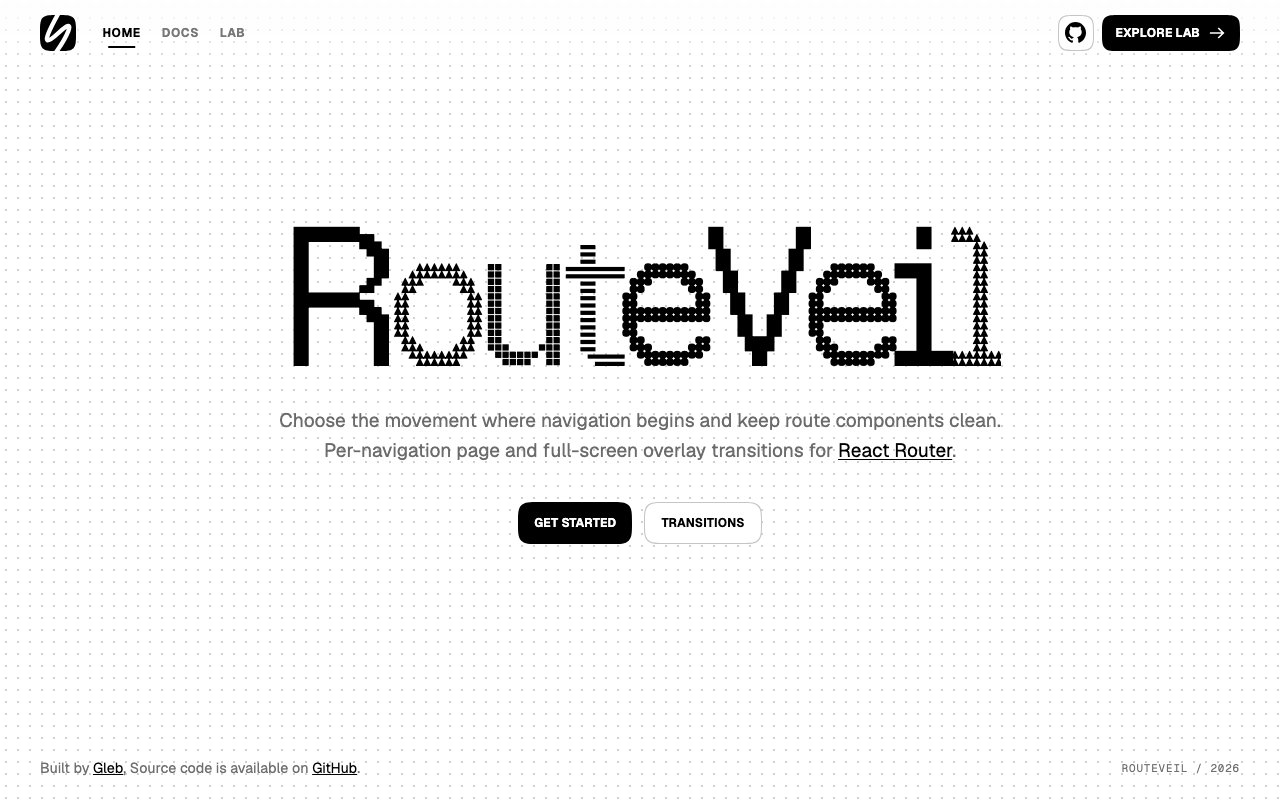
Routeveil is a transition engine for React Router that handles page animations, shared elements, and full-screen overlays. It lets you define per-navigation transitions while keeping your route components clean. The library is TypeScript-native and works with React 18, React 19, and React Router DOM versions 6.27 and above.
The core problem it addresses is that React Router handles navigation but not the visual transitions between routes. You can get from page A to page B, but making that movement feel smooth, with elements that persist across routes or pages that slide in and out, requires custom work. Routeveil provides the infrastructure for those effects without taking over your routing.
The library ships three main components. RouteveilView wraps your route content and manages the transition lifecycle. RouteveilLink replaces your navigation links and triggers the transitions. RouteveilSharedElement marks elements that should animate between routes, connecting them with unique identifiers. When you navigate, the exit animation plays, then shared elements move to their new positions, then the enter animation runs.
Shared element handling is where it gets useful. You mark an element on one page and a matching element on another, and Routeveil figures out how to animate between them. It handles multiple concurrent matches, crossfades between different element types, and gracefully skips missing or duplicate targets. The scroll management keeps incoming shared elements centered without breaking URL hash anchors.
Routeveil also provides programmatic hooks for triggering transitions outside of link clicks, plus deterministic cleanup for interrupted navigation. If a user clicks away mid-transition, it cleans up animations, overlays, and focus state properly. Reduced-motion support is built in for accessibility.
This fits frontend developers building React applications where navigation should feel polished rather than instant. Product pages that share images with listing pages, dashboards with expanding cards, apps where the transition itself communicates structure. The library is MIT licensed, free to use, and distributed through npm.
Key Features
- Per-navigation transition customization
- Shared element movement across routes
- Full-screen overlay effects
- Type-safe transition options
- Programmatic navigation and playback hooks
- Reduced-motion accessibility support
Pros & Cons
What we like
- Works with both React 18 and React 19
- Shared elements animate without wrapper components
- Handles interrupted navigation cleanly
- MIT licensed with no cost to use
Room for improvement
- Requires React Router DOM 6.27 or higher
- Depends on Web Animations API browser support
- Smaller community as a newer library
- Adds complexity to simpler navigation flows
Frequently Asked Questions
What is Routeveil?
Is Routeveil free?
What versions of React does Routeveil support?
How do shared elements work?
Best For
Featured in
Alternatives to Routeveil
View allCursor
VS Code fork built around an AI pair-programmer

Sanity
Composable content platform with a customizable studio, real-time collaboration, and a queryable structured content backend.

PostHog
All-in-one product analytics, feature flags, and session replay
Cloudflare Pages
Free Jamstack hosting on Cloudflares edge with unlimited bandwidth and tight integration with Workers.
Reviews (0)
Badge builder
Add Routeveil to your website
Choose a badge style and size, preview it here, then copy the generated HTML. Badge images are self-contained SVGs and do not require an external script.

<a href="https://toolindex.net/tools/routeveil?ref=badge" target="_blank" rel="noopener">
  <img src="https://toolindex.net/badge/routeveil/medium.svg" alt="Routeveil - Listed on Tool Index" width="180" height="50" />
</a>How to use the badge
- 1. Pick the style, size, and theme that fit your layout.
- 2. Copy the generated HTML from the code block.
- 3. Paste it into your footer, homepage, or press page.
Standard badge available
The standard listing badge is available now. Score and circle badges are limited to tools currently ranked in the top 10 of a category.
Badge clicks return visitors to this profile with a referral tag so the source remains identifiable.
Related Tools

Kevin Gabeci
Solo developer building web apps, cozy browser games, and AI creator toolkits.

Warp
The modern terminal reimagined with AI and collaboration

Bolt.new
Prompt-to-deployed full-stack app inside the browser

Supabase
The open source Firebase alternative
Work on Routeveil? Request listing access or correction