SourceMinder
Local CLI toolkit that indexes codebases by symbol for token-efficient AI search
Gallery
About SourceMinder
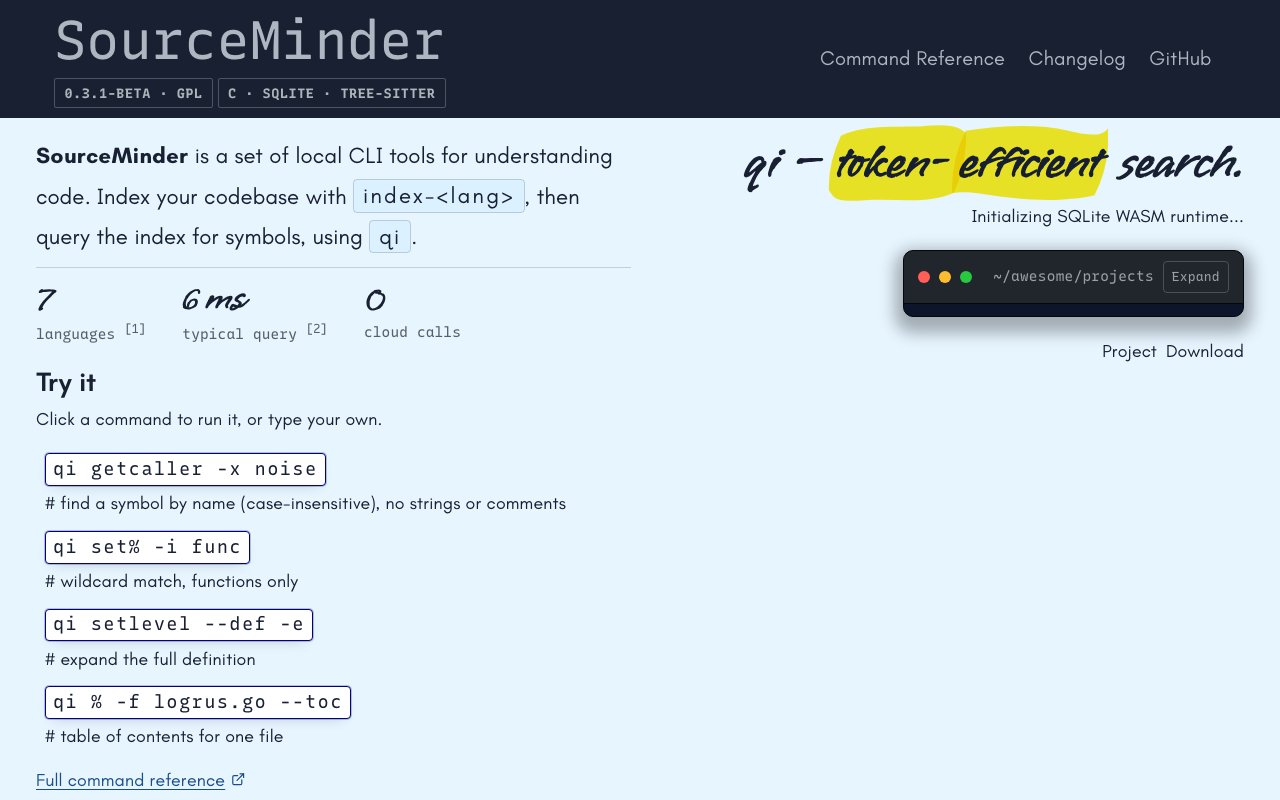
SourceMinder is a command line tool that indexes your codebase by symbol so AI agents and language models can search it efficiently without shipping the whole thing to a cloud service. It parses source files locally using Tree-sitter, builds a symbol database, and lets you query that database in milliseconds. The goal is reducing the token overhead that comes with naive approaches like grepping and concatenating files.
The problem it addresses is familiar to anyone who has tried to point an LLM at a large codebase. You can dump files into context, but that burns tokens fast and often sends irrelevant code. SourceMinder builds an index once, then queries return just the symbols you need, typically in around six milliseconds across a quarter million symbol index. The claim is roughly fifteen percent fewer tokens compared to grep and cat workflows.
It runs entirely on your machine. There are no cloud calls, no API keys, and no data leaving your network. The index lives locally, and you query it with a tool called qi that supports wildcards, type filters, and options to expand definitions or exclude comments. You build the index with language specific commands, one per supported language.
Language support currently includes C, Go, Perl, PHP, Python, TypeScript, and Rust, with Rust and Perl marked as provisional. The underlying parser is Tree-sitter, which means adding more languages is possible but depends on the maintainers or community contributions.
Installation is a single curl command that pulls a prebuilt binary. It ships ready for x86_64 Linux, with support for macOS and BSD as well. The project is licensed under GPL v3, so you can inspect the source and contribute if you want to extend it.
The audience is developers who use AI coding assistants or build their own agent workflows and want tighter control over what context gets sent. If you have a large codebase and are tired of watching token counts balloon, SourceMinder offers a way to query for exactly what you need instead of grabbing everything and hoping the model filters it out.
It is free and open source. The current version is 0.3.1 beta, so it is still maturing, but the core indexing and querying workflow is functional and documented on GitHub.
Key Features
- Symbol-based codebase indexing via Tree-sitter
- Six millisecond typical query time
- Wildcard and type filter support
- Entirely local with zero cloud calls
- Fifteen percent token reduction vs grep workflows
- Single binary install via curl
Pros & Cons
What we like
- Runs fully local with no API keys or cloud dependencies
- Fast queries even on large codebases
- Open source under GPL v3
- Reduces token usage for AI context windows
Room for improvement
- Language support limited to seven languages currently
- Beta status means rough edges may remain
- Requires initial index build per language
- No GUI, command line only
Frequently Asked Questions
What is SourceMinder?
Is SourceMinder free?
What languages does SourceMinder support?
Who is SourceMinder for?
Best For
Featured in
Alternatives to SourceMinder
View allCursor
VS Code fork built around an AI pair-programmer

Sanity
Composable content platform with a customizable studio, real-time collaboration, and a queryable structured content backend.

PostHog
All-in-one product analytics, feature flags, and session replay
Cloudflare Pages
Free Jamstack hosting on Cloudflares edge with unlimited bandwidth and tight integration with Workers.
Reviews (0)
Badge builder
Add SourceMinder to your website
Choose a badge style and size, preview it here, then copy the generated HTML. Badge images are self-contained SVGs and do not require an external script.

<a href="https://toolindex.net/tools/sourceminder?ref=badge" target="_blank" rel="noopener">
  <img src="https://toolindex.net/badge/sourceminder/medium.svg" alt="SourceMinder - Listed on Tool Index" width="180" height="50" />
</a>How to use the badge
- 1. Pick the style, size, and theme that fit your layout.
- 2. Copy the generated HTML from the code block.
- 3. Paste it into your footer, homepage, or press page.
Standard badge available
The standard listing badge is available now. Score and circle badges are limited to tools currently ranked in the top 10 of a category.
Badge clicks return visitors to this profile with a referral tag so the source remains identifiable.
Related Tools

Kevin Gabeci
Solo developer building web apps, cozy browser games, and AI creator toolkits.

Warp
The modern terminal reimagined with AI and collaboration

Bolt.new
Prompt-to-deployed full-stack app inside the browser

Supabase
The open source Firebase alternative
Work on SourceMinder? Request listing access or correction