
Suno
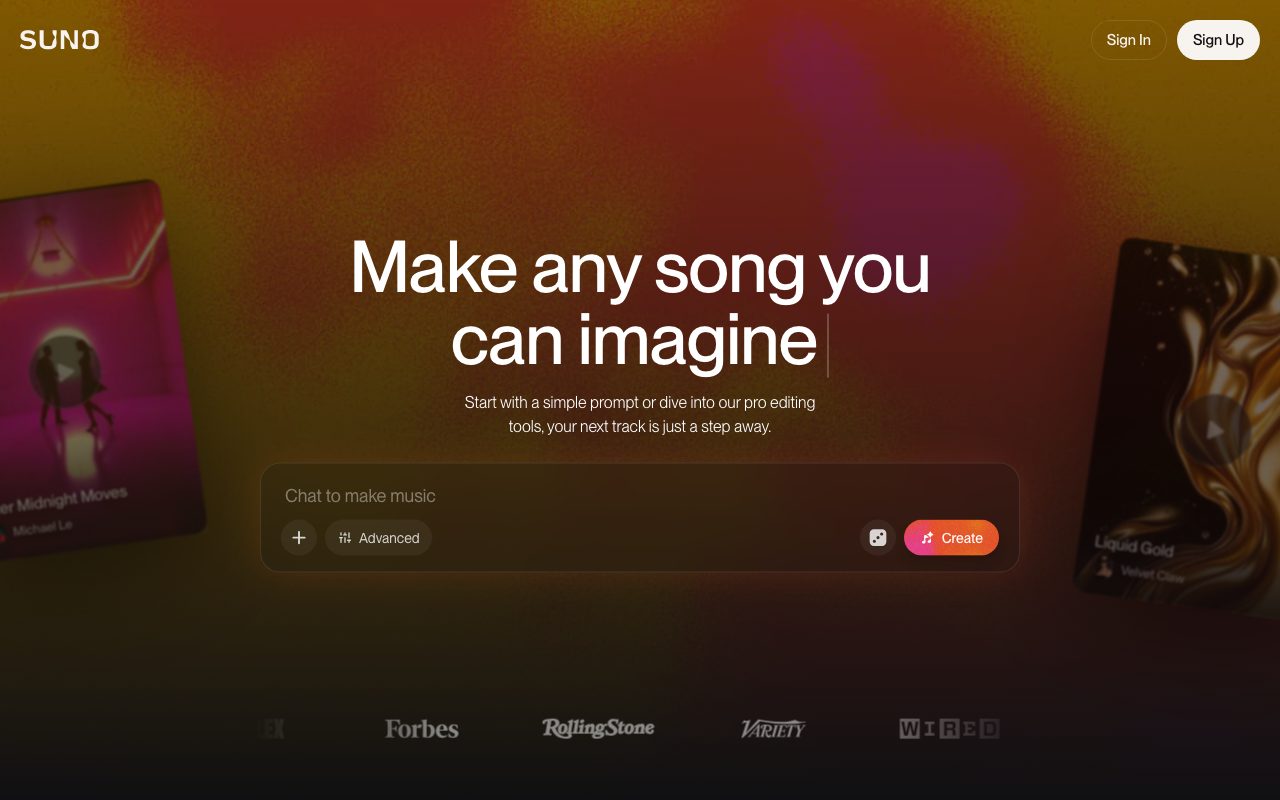
Generate full songs from a prompt, including vocals, lyrics, and all.
Gallery
About Suno
Suno generates full songs from a text prompt: lyrics, vocals, instruments, the whole thing. It's the AI music tool that crossed over from "neat demo" to "people are actually shipping music with this."
The output isn't always perfect. Sometimes the vocals slip. Sometimes the bridge doesn't quite land. But the floor of what Suno can do has gotten high enough that it's reshaping how creators approach music.
If you've watched the AI music space and wondered when it'd produce something usable, Suno is when. Udio is the other major name in the same conversation.
What Suno actually does
You write a prompt, optionally add custom lyrics, pick a style, and Suno generates a full song. Vocals, instruments, structure. You get an audio file you can download and use.
The custom mode lets you write your own lyrics and pick a genre. The simple mode just takes a prompt and runs. Both modes produce songs in under a minute.
Style and genre control
You can specify "indie folk with acoustic guitar and warm vocals" or "synthwave with vintage drum machines" and Suno will produce something credibly in that lane. The genre vocabulary is broad.
Who Suno is for
Content creators needing background music. Indie game devs scoring small projects. Marketers making jingles. Hobbyists making songs for friends and family. Songwriters using it as a co-writer to spark ideas.
It's not for label-quality production. The output gets close, but you'll still hear the AI tells if you listen carefully. Pros use it for ideation, not final masters.
The "song for my niece's birthday" use case
Personal songs are a huge slice of Suno's traffic. Birthdays, weddings, inside jokes. AI music shines when emotional resonance matters more than technical perfection.
Pricing breakdown
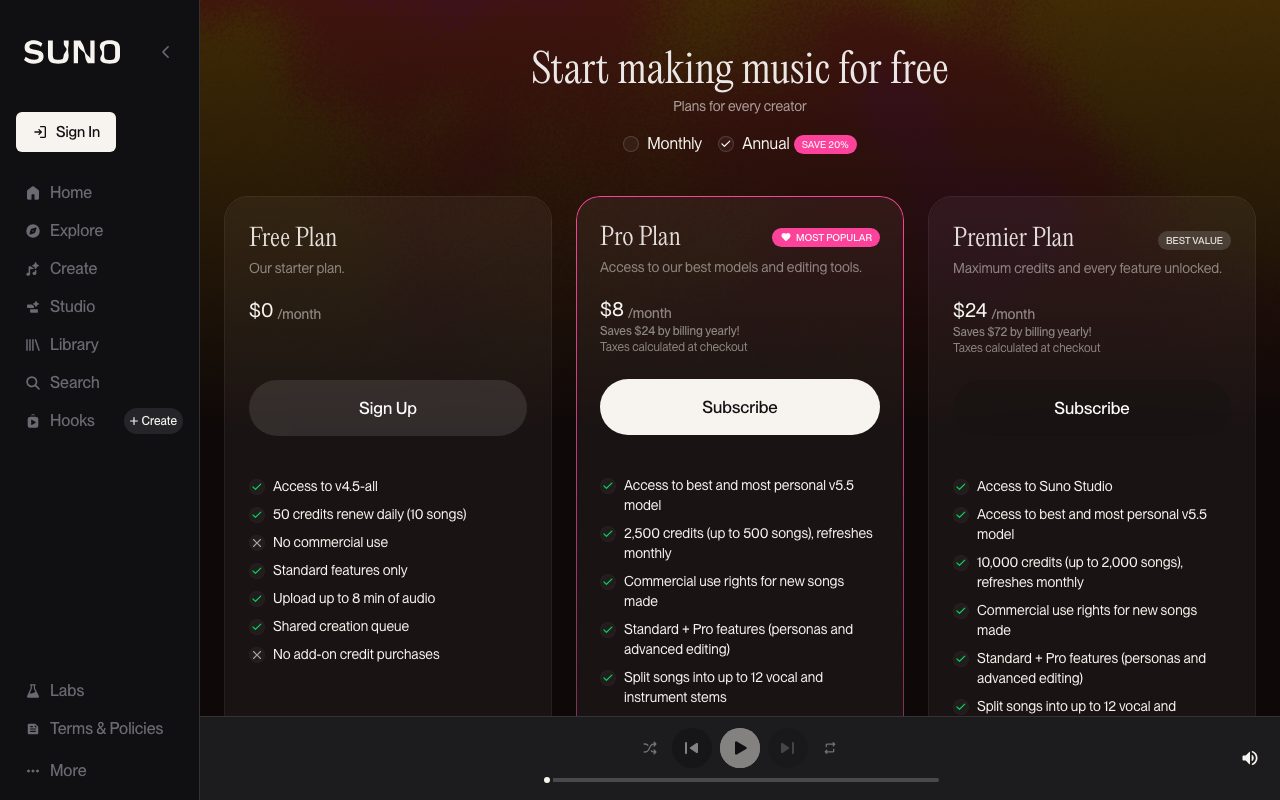
Free tier with a small daily generation allowance. Pro and Premier tiers add more credits, faster generation, and commercial usage rights.
The free tier is good for experimentation. Pro is where most regular users land. The commercial-rights distinction matters if you're using songs in monetized content.
Commercial use clarity
Free-tier songs are personal-use only. Paid-tier songs come with broader rights. Read the terms if you're shipping Suno output in client work or monetized videos.
Standout features of Suno
Vocal generation. Most AI music tools punted on vocals because they're hard. Suno made them work, and that's the entire reason the tool blew up.
Lyrics. The auto-generated lyrics are surprisingly coherent. Not Pulitzer material but they rhyme, they stay on theme, and they don't trip over themselves.
Extension and remixing
You can extend a generated song, take an existing track and "continue" it, or replace sections. This iterative editing is a real workflow advantage.
Honest tradeoffs with Suno
The AI tells are still there. Vocals occasionally warble. Mixes can feel compressed. If you're A/B testing against a real producer's work, the gap is audible.
The legal landscape is messy. AI music sits in unsettled copyright territory. If you're using output commercially, get clarity on rights before betting a brand on it.
Suno is the moment AI music stopped being a curiosity and started being a tool people actually reach for. The vibe shift is real.
Suno vs alternatives
Suno vs Udio: Udio is the closest peer. Audio quality is comparable. Pick on UI preference and pricing.
Suno vs AIVA: AIVA is more classical and instrumental. Suno is broader and vocal-first.
Suno vs Melodex: Melodex extends into video. Suno stays focused on audio.
For more options, see the best AI music tools or check Udio alternatives and Suno vs Udio.
When Suno wins
You want a full song, not a backing track. You want vocals. You want speed.
Bottom line on Suno
Suno is the AI music tool that proved the technology was ready for real use. It's not perfect, but it's good enough to ship, and that's the whole point.
If you're an audiophile or a label producer, you'll find the tells. For everyone else, Suno is a remarkable creative tool. See tools for content creators for adjacent picks.
How Suno's vocal model changes things
The reason Suno crossed over from demo to real tool is the vocals. Instrumental AI music has been around for years. AI vocals that don't sound robotic are new. That single capability unlocks a flood of use cases.
Songs are emotional because of voices. Without vocals, AI music was always background. With vocals, AI music can be foreground. That's the shift Suno represents.
The lyrics that aren't terrible
Auto-generated lyrics rhyme, stay on theme, and avoid the worst AI tics most of the time. They're not great poetry but they're not embarrassing either. For most use cases, that's enough.
Suno in real workflows
Indie game devs use Suno for soundtrack drafts. YouTubers use it for intro and outro music. Marketers use it for jingles and ads. Songwriters use it as a co-writer to spark ideas they then re-record properly.
Each use case has a different bar for quality. Suno's flexibility across these workflows is part of why it's spread.
Extension and continuation
You can take a generated track and extend it, add new sections, or replace specific parts. This iterative editing is rare in AI music tools and changes how you work with generated music.
Common Suno questions
Can you use Suno songs commercially? Yes on paid tiers, check current terms. How long can songs be? Several minutes with extensions. Does Suno support multiple languages? Yes, lyrics work in many languages.
For more, see tools for game developers and Suno vs Udio.
Final take on Suno
Suno is the AI music tool that proved the technology had crossed the usability threshold. It's not perfect but it's good enough to ship songs people genuinely enjoy. That's a genuine inflection point in creative AI.
Custom mode versus simple mode in Suno
Simple mode takes a prompt, generates lyrics, and produces a song in one go. It's the casual entry point. Custom mode lets you write your own lyrics, pick precise styles, and control structure. Most serious users live in custom mode.
The lyrics field accepts standard verse-chorus markers. You can specify "intro," "verse," "chorus," "bridge," and "outro." Suno honors these structural cues and produces songs that follow your map.
The genre and style vocabulary
You can describe styles in natural language: "lo-fi hip-hop with jazz chords and vinyl crackle." Suno parses these descriptions and produces credible matches. The vocabulary is broad enough to cover obscure subgenres if you describe them accurately.
Suno for creative workflows
Songwriters use Suno as a co-writer. You generate a draft, listen, and use it as a starting point for human re-recording. The AI version sparks ideas you wouldn't have had alone. The human version captures emotional nuance the AI misses.
This co-writing pattern is different from the "AI replaces musicians" panic. It's collaborative, with the AI handling the boring parts (drafting many variations quickly) and the human handling the meaningful parts (selecting, editing, performing).
Commercial usage and rights
Paid-tier Suno songs come with broader commercial rights. You can use them in monetized YouTube videos, paid ads, and similar contexts. The exact terms shift as the AI music legal landscape evolves, so check current terms before betting a brand on AI music.
The legal questions around AI music training data and copyright are unsettled. Suno has policies. Lawsuits exist. The space will keep evolving. Use accordingly and don't over-leverage AI-generated music in contexts where rights clarity is critical.
Audio quality reality check
Suno's vocals are surprisingly good but still have AI tells. The mix can feel slightly compressed compared to professional production. For background music in videos, podcasts, and casual content, this is fine. For foreground music in serious productions, you'll want professional mastering or human re-recording.
Suno's iteration features
Extension lets you grow a song past its initial length. Continuation generates more of an existing track. Cover lets you re-record an existing song in a different style. Replace lets you swap sections. The toolkit is genuinely rich.
This iteration is what makes Suno feel less like a one-shot generator and more like a creative tool. You're not stuck with the first roll. You can shape the output through multiple passes.
Sharing and community
Suno's public library shows what others are making. You can explore by genre, style, or popularity. The community vibe is real. Many users post songs publicly even though private generation is supported. The exposure helps creators build audiences.
Suno for indie creators specifically
Game developers use Suno for soundtrack drafts during development. They might re-record final tracks with composers but the drafts let them prototype with mood-appropriate music early. This is a real workflow change for solo developers.
YouTubers, podcasters, and TikTokers all benefit similarly. AI music removes the licensing-versus-copyright friction that plagued background music for indie creators for years. Suno doesn't fully solve it, but it makes the friction much lower.
Suno wrap-up
The platform represents an inflection point in AI music. The technology has crossed the usability threshold. Real creators are shipping real songs that sound credibly good. The economics of music creation are changing in ways the industry is still processing.
For creators integrating Suno into workflows, the practical advice is to be deliberate about where AI music adds value and where human craft still matters. Background music, jingles, sketches, and ideation drafts all work well. Foreground emotional moments often benefit from human vocalists and producers.
The legal considerations
The legal landscape for AI music is unsettled. Use Suno output in commercial contexts with awareness of evolving terms. Read the platform's commercial usage policy carefully if you're betting a brand campaign on Suno-generated music. The space will mature but for now, professional caution is warranted on the rights side.
Tutorial / Demo
Key Features
- Full-song generation with vocals and instruments
- Custom lyrics or AI-written lyrics
- Stem download (drums, bass, vocals, etc.)
- Song extension and editing
- Persona references for consistent style
- Cover and remaster of existing recordings
Pros & Cons
What we like
- Output is genuinely listenable, not novelty
- Lyric writing and melody are coherent
- Stems unlock downstream remix work
- Big creative range across genres
Room for improvement
- Ongoing copyright litigation with major labels, leaving the long-term legal status uncertain
- Vocals occasionally slip into uncanny territory
- Free tier has heavy daily caps
- Commercial usage rights vary by plan
Frequently Asked Questions
Does Suno have a free tier?
Suno vs Udio, which is better?
Can I use Suno songs commercially?
Does Suno give me stems or just the final mix?
Can Suno clone a specific artist's voice?
Best For
Featured in
Tags
Alternatives to Suno
View all
Stable Audio
Stability AI's text-to-audio model for generating original music and sound effects from a written prompt

Soundraw
AI music generator that builds royalty-free, fully customizable songs from a mood and genre in seconds

Boomy
Make original AI songs in seconds and distribute them to Spotify, Apple Music, and 40+ streaming platforms
AIVA
AI music composer built for cinematic and classical soundtracks, with 250+ styles and a MIDI editor
Our take
Tool Index Editorial · May 2026· 4.6/5
What Suno is really selling — beyond the marketing copy — is generate full songs from a prompt, including vocals, lyrics, and all.
On the strengths side: Output is genuinely listenable, not novelty, Lyric writing and melody are coherent, and Stems unlock downstream remix work. What to watch for: Ongoing copyright litigation with major labels, leaving the long-term legal status uncertain and Vocals occasionally slip into uncanny territory.
Recommendation: this is a strong default when you need background music for videos and podcasts. If ongoing copyright litigation with major labels, leaving the long-term legal status uncertain would be a dealbreaker, the alternatives section below is worth a scroll.
Editorial opinion from the Tool Index team, written from the public product pages. Not a user review.
Reviews (10)
Honest take after a few weeks
Hadn't planned on switching, but Suno was hard to ignore. Real selling point: output is genuinely listenable, not novelty. Their take on custom lyrics or AI-written lyrics is solid. Main use case: replacing stock music libraries.
Pros
- Lyric writing and melody are coherent
Pulled its weight from week one
Found Suno on a Reddit thread, glad I clicked. Genuine strength: output is genuinely listenable, not novelty. Got real value out of persona references for consistent style.
Pros
- Stems unlock downstream remix work
Maybe in a year when they fix the basics
Found Suno on a Reddit thread, glad I clicked. The thing I keep coming back to: output is genuinely listenable, not novelty. Their take on persona references for consistent style is solid. Wish they'd address how vocals occasionally slip into uncanny territory. Probably better for someone with different needs.
Pros
- Stems unlock downstream remix work
Cons
- Commercial usage rights vary by plan
Suno, better than expected
Found Suno on a Reddit thread, glad I clicked. What stands out is how output is genuinely listenable, not novelty. Their take on stem download (drums, bass, vocals, etc.) is solid. Found it works best for replacing stock music libraries. Glad I made the switch.
Pros
- Output is genuinely listenable, not novelty
Two months in, no regrets
A month of using Suno, here's what holds up. The biggest win has been lyric writing and melody are coherent. Full-song generation with vocals and instruments works the way you'd hope. It fits well for songwriting demos and idea exploration. Honest gripe: ongoing copyright litigation with major labels — long-term legal status uncertain. Would buy again without thinking twice.
Pros
- Stems unlock downstream remix work
- Big creative range across genres
- Output is genuinely listenable, not novelty
Recommended without reservation
Have been using Suno for a while, here's where I land. Genuine strength: big creative range across genres. Song extension and editing works the way you'd hope. Found it works best for background music for videos and podcasts. Still recommending it to people in similar setups.
Pros
- Big creative range across genres
- Stems unlock downstream remix work
- Output is genuinely listenable, not novelty
It just works
Picked Suno for the lower price, stayed for the actual quality. Genuine strength: lyric writing and melody are coherent. Worth calling out the persona references for consistent style too.
Pros
- Big creative range across genres
- Lyric writing and melody are coherent
Quietly excellent
Started using Suno casually, now it's pinned in my dock. Where it really wins is stems unlock downstream remix work. Their take on song extension and editing is solid. It fits well for background music for videos and podcasts. Glad I made the switch.
Pros
- Lyric writing and melody are coherent
- Big creative range across genres
- Stems unlock downstream remix work
Pulled its weight from week one
Suno solves a real problem for me, but it's not magic. Genuine strength: output is genuinely listenable, not novelty. Got real value out of custom lyrics or AI-written lyrics. Hard to imagine going back to my previous setup.
Recommended without reservation
Picked Suno for the lower price, stayed for the actual quality. The biggest win has been output is genuinely listenable, not novelty.
Pros
- Output is genuinely listenable, not novelty
- Big creative range across genres
Badge builder
Add Suno to your website
Choose a badge style and size, preview it here, then copy the generated HTML. Badge images are self-contained SVGs and do not require an external script.

<a href="https://toolindex.net/tools/suno?ref=badge" target="_blank" rel="noopener">
  <img src="https://toolindex.net/badge/suno/medium.svg" alt="Suno - Listed on Tool Index" width="180" height="50" />
</a>How to use the badge
- 1. Pick the style, size, and theme that fit your layout.
- 2. Copy the generated HTML from the code block.
- 3. Paste it into your footer, homepage, or press page.
Score badge available
Suno qualifies for the score and circle badges based on its current top-10 positionin AI Music Generators.
Badge clicks return visitors to this profile with a referral tag so the source remains identifiable.
Related Tools

Apatero AI
The creator studio for AI image, video, audio, 3D, and avatars, now at apatero.ai.
Kevin Gabeci Toolkits
Seven AI toolkits for writing books, making music, cutting video, and building agents.

Warp
The modern terminal reimagined with AI and collaboration

Bolt.new
Prompt-to-deployed full-stack app inside the browser
Work on Suno? Request listing access or correction