
Textlog
Text-only community platform with a free public API for building feeds, bots, and embeds
Gallery
About Textlog
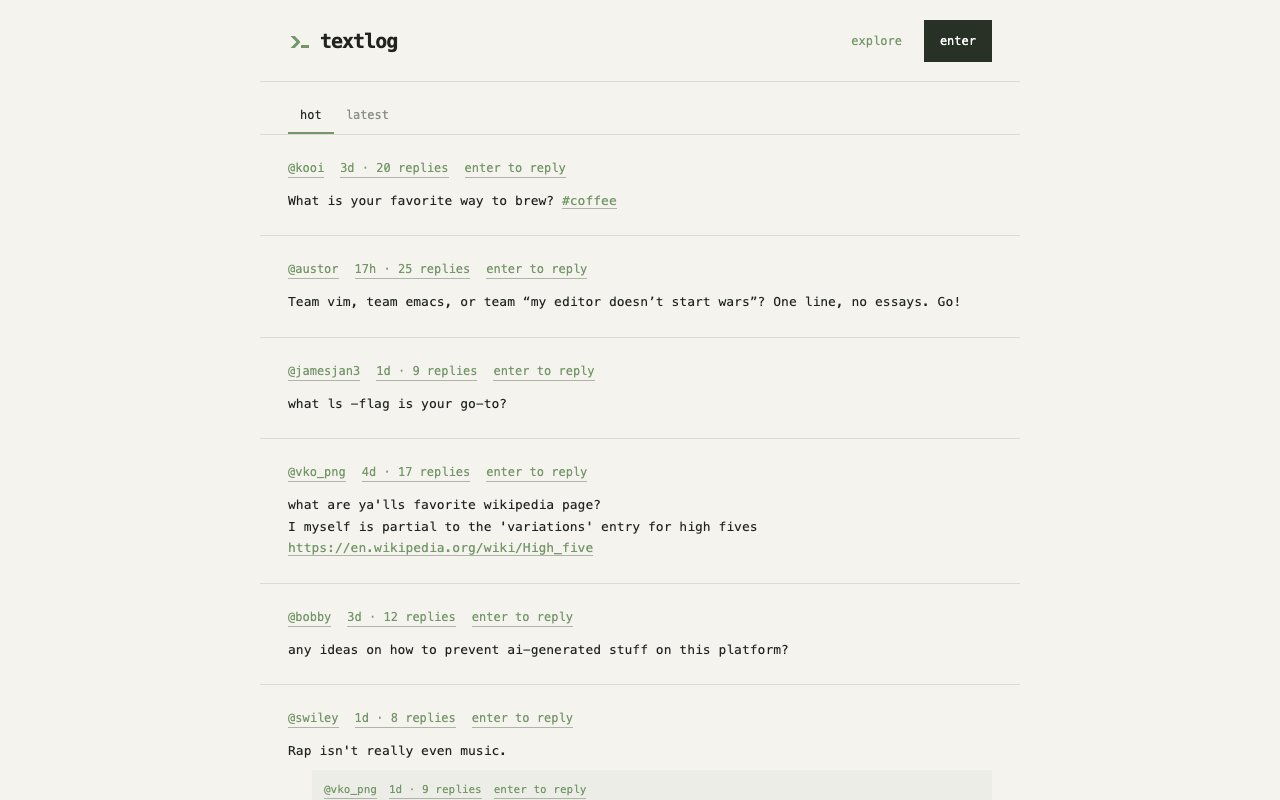
Textlog is a small, text-only community platform where people post short thoughts, reply in threads, and browse discussions grouped under hashtags like #vim, #coffee, and #blog. It looks and feels closer to an old-school message board than a modern social network, with a monospace aesthetic, light and dark themes, and a feed you simply read from top to bottom. Alongside the site itself, Textlog publishes a full public API, and that second half is what makes it interesting to developers. The whole platform is designed to be read from, written to, and built on, which is rare in an era when the big networks have locked their APIs behind paywalls.
The community side works the way you'd hope. There's a latest feed and a hot feed, hashtags group conversations by topic, and every post can carry a thread of replies. Timestamps and reply counts sit next to each post, so you can tell at a glance which threads are alive. Posting is deliberately throttled to three posts per five minutes, which keeps the feed slow and readable instead of a firehose. The crowd skews technical, with running conversations about editors, personal blogs, coffee brewing, sleep schedules, and AI experiments. If you'd rather not use the website, there's a companion mobile app built with Flutter, and an IRC channel on Libera Chat for people who prefer to hang out in a terminal.
The API is where the invitation to build on Textlog comes in. Reading is completely public with no authentication required, so you can pull the latest posts, trending content, hashtag feeds, search results, and user profiles with plain HTTP requests. Writing requires a bearer token, which any account can obtain through an email verification code, and you can generate API keys for long-running integrations. Authentication is refreshingly simple, you sign in with a code sent to your email and get a token back, with no developer portal or app review process in the way. In total there are more than twenty endpoints covering posts, replies, profiles, follows, and blocks. There's also a real-time firehose of new posts delivered over server-sent events, plus RSS and Atom feeds for anyone who'd rather subscribe than poll. None of it requires scraping or reverse engineering, the endpoints are documented and meant to be used.
Rate limits are published up front and mirror the website's own rules. Reads are capped at 120 requests per minute per IP address, writes at 60 per hour per account, and posting at the same three-per-five-minutes cadence as the site. That transparency matters when you're building a widget, a bot, or an embed, because you know exactly what the platform will tolerate before you ship anything. The docs frame the API around concrete projects, feeds, profile cards, post embeds, and live widgets, which gives you a decent sense of what the maintainers expect people to make.
Textlog fits two overlapping groups. The first is people who miss small internet communities, the kind where the same few dozen usernames show up every week and conversations stay readable without an algorithm deciding what you see. The second is developers who want a friendly, open playground for building against a real social platform without fighting an OAuth gauntlet or paying for read access. If you've wanted to experiment with a firehose stream, a feed renderer, or a posting bot, this is one of the few places left where you can do it with nothing but curl and an email address. Students and hobbyists get a realistic sandbox too, since the same patterns that power the big networks, feeds, threads, follows, and streams, are all here at a scale you can actually understand.
What sets it apart is posture rather than features. The code is open source on GitHub, the API is free and public, reading requires no account at all, and the project runs on donations rather than ads or subscriptions. There's no growth machinery, no engagement ranking beyond a simple hot feed, and no monetization pressure warping the product. That also means the community sets the tone, and right now the tone is friendly, slow, and unmistakably nerdy. The obvious trade-off is scale. This is a niche community, so you won't reach a mass audience here, and the strict rate limits mean high-volume applications aren't really the point.
Access is free across the board. You can read the site and the API without an account, sign up with an email code when you want to post, and chip in through the donation link if you'd like the project to stick around. For anyone looking for a small, hackable social platform to build against, or just a quieter corner of the internet to post in, Textlog costs nothing to try beyond a few minutes of your time.
Key Features
- Public read API without authentication
- Real-time firehose over server-sent events
- Hashtag-based discussion feeds
- Threaded replies on every post
- RSS and Atom feed support
- Open-source codebase on GitHub
Pros & Cons
What we like
- Free public API with no developer portal or approval process
- Donation-supported, so no ads or paid gates
- Published, transparent rate limits
- Companion Flutter mobile app and IRC channel
Room for improvement
- Small niche community, so reach is limited
- Tight posting throttle of three posts per five minutes
- Rate limits are modest for high-volume applications
- Developer-leaning culture won't fit general audiences
Frequently Asked Questions
What is Textlog?
Is Textlog free?
Do I need an API key to use the Textlog API?
Who is Textlog for?
Best For
Featured in
Alternatives to Textlog

ChatDash
White-label platform to deliver, manage, and monetize AI voice agents under your own brand

CalendHub
Smart scheduling and calendar management for teams

Zoom
The default video meeting tool of the post-2020 internet

Substack
Hosted newsletter and publication platform with built-in payments, recommendations, and an audience network for writers.
Reviews (0)
Badge builder
Add Textlog to your website
Choose a badge style and size, preview it here, then copy the generated HTML. Badge images are self-contained SVGs and do not require an external script.

<a href="https://toolindex.net/tools/textlog?ref=badge" target="_blank" rel="noopener">
  <img src="https://toolindex.net/badge/textlog/medium.svg" alt="Textlog - Listed on Tool Index" width="180" height="50" />
</a>How to use the badge
- 1. Pick the style, size, and theme that fit your layout.
- 2. Copy the generated HTML from the code block.
- 3. Paste it into your footer, homepage, or press page.
Standard badge available
The standard listing badge is available now. Score and circle badges are limited to tools currently ranked in the top 10 of a category.
Badge clicks return visitors to this profile with a referral tag so the source remains identifiable.
Related Tools
Substack
Hosted newsletter and publication platform with built-in payments, recommendations, and an audience network for writers.

MailerLite
Friendly, affordable email marketing tool with newsletters, automations, landing pages, and a growing creator toolkit.

Twist
Calmer team messaging where threads replace the firehose of channels

Zulip
Threaded team chat that treats topics as a first-class concept
Work on Textlog? Request listing access or correction