
Gallery
About 1Baton
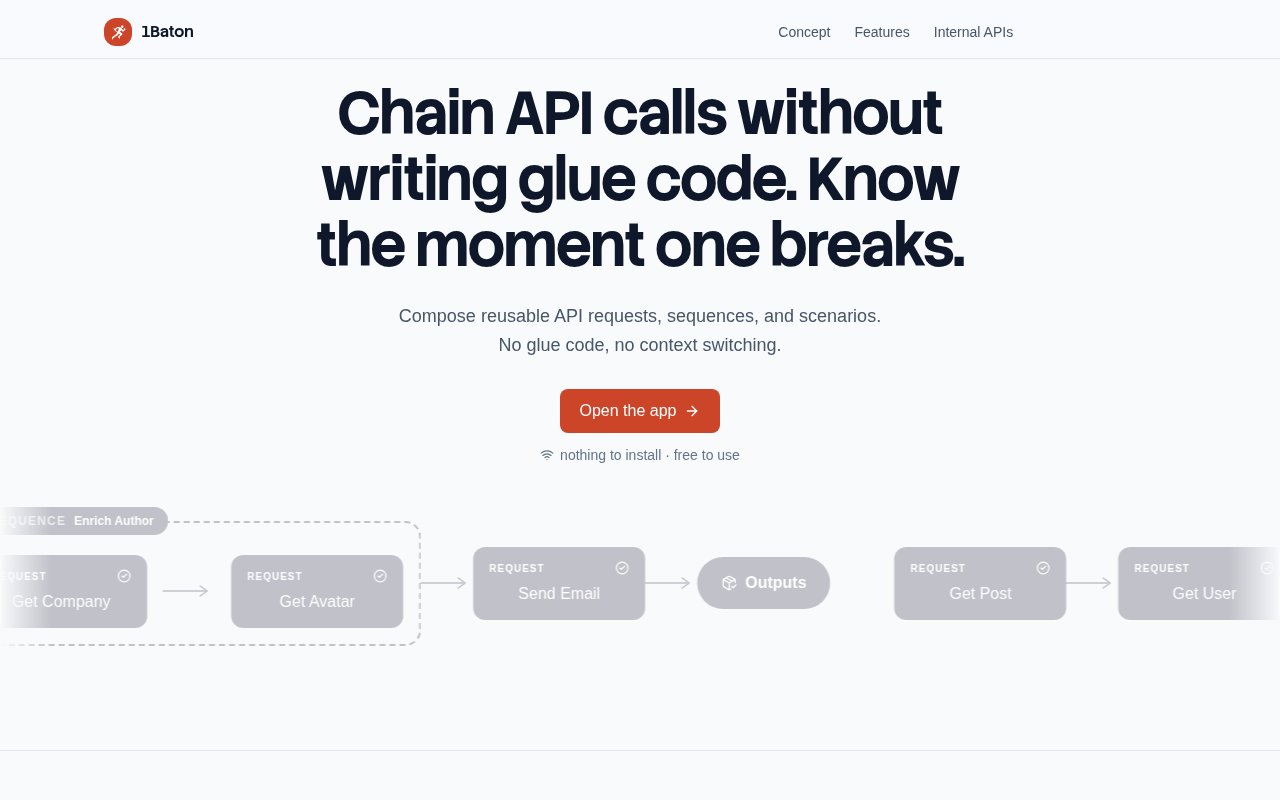
1Baton is a browser-based tool for authoring and running API integration tests as reusable visual flows. It is built for the point where testing one endpoint at a time stops representing the real behavior of a service. A checkout, onboarding, or account setup flow might require several HTTP calls in a specific order, with identifiers and other values moving from one response into later requests. 1Baton lets a developer define those calls once, connect them without custom glue code, and assemble them into runnable scenarios.
The product uses three main building blocks. A request describes one HTTP call together with the inputs it needs and outputs it exposes. A sequence groups requests into an ordered, parameterized unit, with output values from an earlier request available to later steps. A scenario combines requests and sequences into the concrete test that gets run. This separation is meant to reduce duplication. A sequence for creating a user or adding an item to a cart can be defined once, then reused in several scenarios with different inputs instead of being copied into a new script each time.
The editor checks the structure before execution. If a request or sequence is missing a required parameter, or a connection becomes stale after the flow changes, 1Baton flags it in the authoring interface. That gives the user a chance to repair the data path before starting a run. Response assertions can be attached to the flow, and the run monitor reports the result of each step as the scenario progresses. The practical benefit is a visible model of the test and its dependencies. Someone reviewing it can follow the calls and value handoffs without first reading a custom fixture layer. The step-level display also makes it easier to locate the first broken handoff in a longer chain.
Authoring happens in the browser, and the current app can test public APIs without a local setup or signup. That makes it easy to sketch a flow, check whether several endpoints cooperate, and share the mental model with another developer or QA engineer. Browser execution has the usual limits when a target API doesn't allow cross-origin requests. For those cases, the project provides an npm runner that can execute outside the browser boundary. The runner and the visual editor serve different parts of the same workflow, with the editor defining the reusable structure and the runner handling execution where browser access is not enough.
The reusable sequence is also the product's answer to test maintenance. If ten scenarios all need the same account creation flow, the shared sequence keeps that setup in one place while each scenario supplies its own concrete values. Outputs are declared instead of being hidden in arbitrary script variables, and missing inputs remain visible to the editor. This won't make a changing API effortless to maintain, but it gives the change a clear place to surface. The same model can help a developer explain a failing business flow to someone who doesn't know the surrounding test harness, since the monitor exposes each step rather than reducing the whole run to one final error. It also separates the reusable definition from the scenario's concrete test values, which is useful when the same business process must be checked with several accounts, products, or permissions.
1Baton is aimed at developers and QA engineers who repeatedly test business processes spread across several endpoints. It isn't trying to be a general replacement for every API client. Its useful unit is the multi-step process, especially when the same preparation or cleanup sequence appears in many tests. A team that already has a mature code-based test framework may prefer the flexibility and review conventions of code. A smaller team, an API designer exploring a workflow, or a tester who wants to avoid boilerplate can get more immediate value from the visual composition model.
The product is still described by its maker as an MVP, and the public materials don't present enterprise administration, broad integrations, or a paid support plan. That early stage is worth weighing if the flow will become part of a critical continuous integration gate. The core, however, is available to try now rather than being only a waitlist or concept page. The browser app runs public API scenarios, the editor models request dependencies, and the npm runner provides a path beyond browser restrictions. No paid tier is published, so access is currently best understood as free while the product and its workflow are being tested with developers.
Key Features
- Visual HTTP request editor
- Reusable parameterized sequences
- Cross-step value passing
- Pre-run dependency validation
- Step-level run monitoring
- Optional npm execution runner
Pros & Cons
What we like
- Removes glue code from common multi-step tests
- Makes request dependencies visible in the editor
- Reuses sequences across different scenarios
- Runs public API tests without initial setup
Room for improvement
- Early MVP with a small user community
- Browser runs depend on target cross-origin policies
- Focused on HTTP flows rather than every test type
- No mature team or enterprise controls are published
Frequently Asked Questions
What is 1Baton?
How are 1Baton tests organized?
Does 1Baton require local setup?
Is 1Baton free?
Best For
Featured in
Alternatives to 1Baton
Playwright
Microsofts open-source end-to-end browser testing framework for Chromium, Firefox, and WebKit with one API.
Selenium Boot
Java testing framework that brings Spring Boot conventions and Playwright APIs to Selenium

Buildkite
Hybrid CI/CD where the control plane is hosted but the build agents run on your own infrastructure.

Storybook
Open-source workshop for building UI components in isolation. Preview, document, and test them outside the app.
Reviews (0)
Badge builder
Add 1Baton to your website
Choose a badge style and size, preview it here, then copy the generated HTML. Badge images are self-contained SVGs and do not require an external script.

<a href="https://toolindex.net/tools/1baton?ref=badge" target="_blank" rel="noopener">
  <img src="https://toolindex.net/badge/1baton/medium.svg" alt="1Baton - Listed on Tool Index" width="180" height="50" />
</a>How to use the badge
- 1. Pick the style, size, and theme that fit your layout.
- 2. Copy the generated HTML from the code block.
- 3. Paste it into your footer, homepage, or press page.
Standard badge available
The standard listing badge is available now. Score and circle badges are limited to tools currently ranked in the top 10 of a category.
Badge clicks return visitors to this profile with a referral tag so the source remains identifiable.
Related Tools
DeviceKit
Free Screen & Device Tests Online | Private Browser Diagnostics

Chromatic
Visual regression testing and review platform built by the Storybook team, with cloud-rendered snapshots and PR integration.
Playwright
Microsofts open-source end-to-end browser testing framework for Chromium, Firefox, and WebKit with one API.

Tests.ws
WebSocket testing tools, protocol guides, and a Chrome extension for developers
Work on 1Baton? Request listing access or correction