
Slite
A focused team wiki that uses AI to keep your knowledge base actually trustworthy
Gallery
About Slite
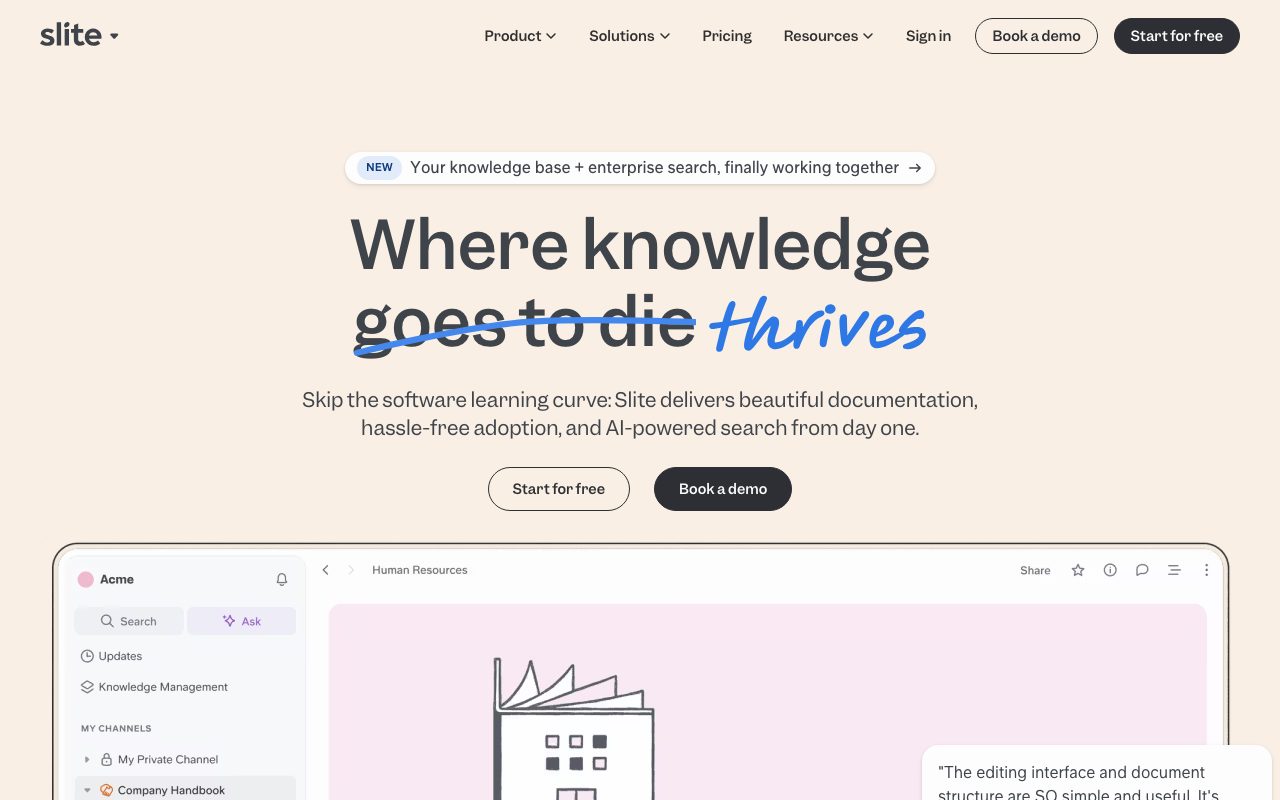
Slite is the focused team wiki built around the question of whether your knowledge base is actually trustworthy. AI-grounded answers that cite real docs, doc verification with owners and review dates, real-time collaboration. The wiki for teams tired of stale docs eroding faith in the whole knowledge base.
Most wikis solve the "where do we put this" problem. Slite tries to solve the harder one: "is what's here still true." That's the angle that makes it interesting in a category that already has Notion, Confluence, and Outline.
For mid-size teams onboarding new hires monthly or running customer support knowledge bases, Slite's verification workflow is genuinely valuable. The smaller integration ecosystem is the price of focus.
What Slite actually does
Channels and collections of pages, with a clean block-based editor. Real-time collaboration, comments, mentions. The standard wiki feature set executed well.
Ask AI is the differentiator. Ask a natural-language question, Slite searches across your docs, generates a grounded answer, and cites the source pages. New hires get reliable answers without spamming Slack.
Doc verification adds owners, review dates, and "needs review" flags. Pages that haven't been verified recently surface visibly. The system gently pushes you to keep docs current rather than letting them rot silently.
Who Slite is for
Teams replacing Notion as a wiki. The doc verification model is one of the few real reasons to switch from a more flexible tool to a more focused one.
Onboarding-heavy organizations. New hires can ask Slite questions and get answers grounded in your real docs. Less Slack noise, faster ramp time, less senior-engineer interruption.
Customer support teams maintaining internal knowledge bases. The combination of search, AI Q and A, and verified status keeps support answers consistent.
Companies that want a wiki, not a workspace. If you don't need databases, project management, or design tools in your knowledge base, Slite's focus is welcome.
Pricing breakdown
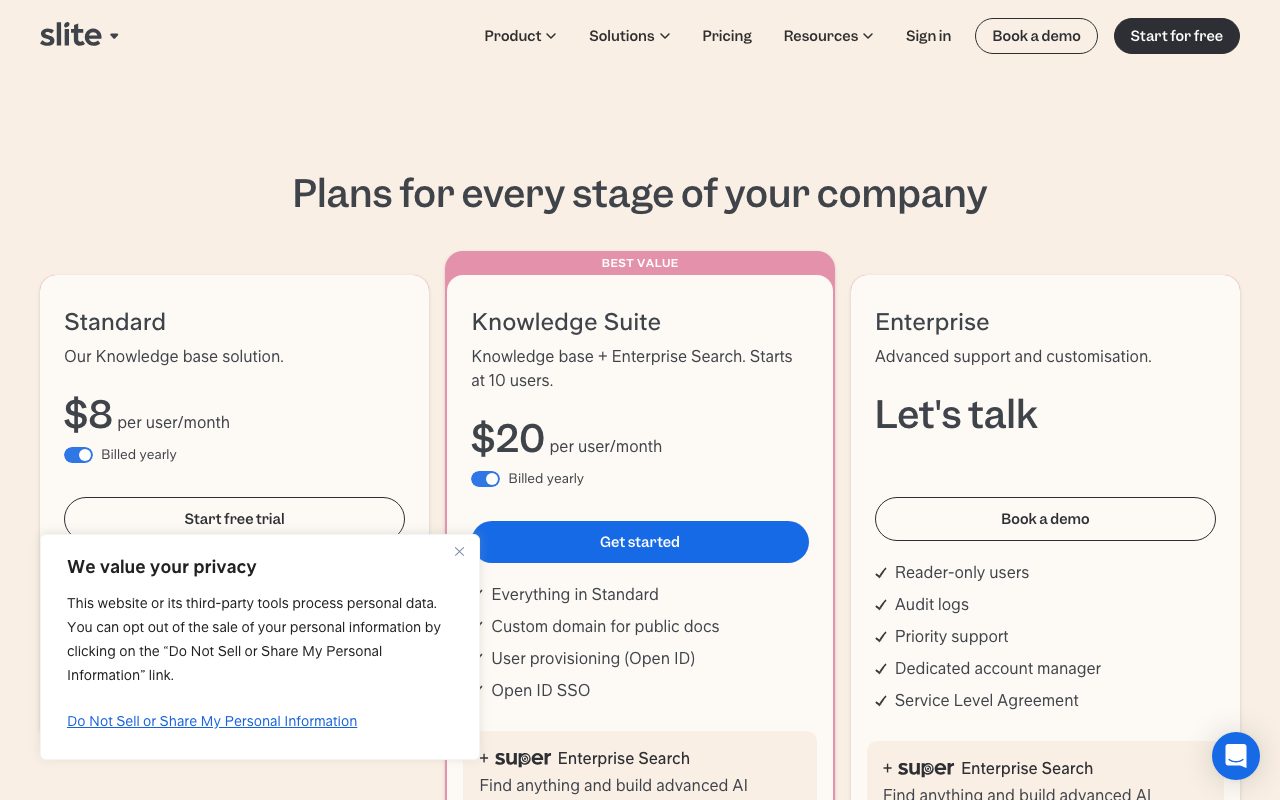
Slite has a free Standard tier with limited storage and basic features. Enough to test on a small team; constrained on serious deployment.
Premium runs around $10 per user per month and unlocks unlimited docs, advanced search, and the verification workflow. AI features layer on top in higher tiers.
Enterprise tiers add SSO, audit logs, and advanced security controls. Pricing is reasonable for the category, especially compared to Confluence's mid-tier pricing at scale.
Standout features in Slite
Doc verification is the headline feature and it earns the spotlight. Owners get review reminders, stale docs get flagged, readers see verification status. The whole knowledge base stays trustworthy without manual gardening sprints.
Ask AI is grounded in your docs, not the open internet. Answers cite source pages so users can verify. The hallucination rate is low because retrieval narrows the context tightly.
The editor is pleasant. Less rich than Notion, faster than Confluence. Strikes a good balance for teams that just want to write and publish docs.
Integrations
Slack, Notion (for migration), Google Workspace, and a few others. Smaller than Confluence's marketplace, sufficient for most modern teams.
Honest tradeoffs
Less flexible than database-style tools. No Notion-style relational databases or kanban boards. Use Slite for docs, project management tools elsewhere.
Smaller marketplace than Confluence. If your stack is exotic, expect to write more glue.
Free plan limits long-term storage. Real teams need to upgrade within a few months of adoption. The upgrade path is reasonable but not optional.
Slite's bet is that knowledge-base trust is a feature worth paying for. Teams who've been burned by stale Confluence pages tend to agree.
Slite vs alternatives
Versus Notion, Slite is more focused and the verification workflow is genuinely better for keeping wikis current. Notion is more flexible. See the comparison.
Versus Confluence, Slite is dramatically lighter and the AI answers are more grounded. Confluence wins on enterprise breadth and Jira ties.
Versus Outline, both are focused wikis. Outline has a better self-hosted story; Slite has the stronger doc-verification model.
For more options, see the best team wikis and Slite alternatives.
Bottom line
Slite is the wiki for teams that have lost faith in their wiki. The verification workflow and grounded AI answers together solve a problem the more famous tools mostly ignore.
If your team treats docs as a system, Slite rewards the discipline with a knowledge base that actually stays trustworthy. If you need databases and a kitchen-sink workspace, Notion is the better fit. For pure wiki use with strong upkeep workflows, Slite is one of the most thoughtful choices in the category.
Getting started with Slite
Set up channels for major team functions. Engineering, product, customer support, internal operations. Channels group docs by audience and access pattern.
Define doc owners early. Every important page should have an owner who's responsible for keeping it current. Slite's verification workflow only works when ownership is assigned.
Train the team to use Ask AI before pinging in Slack. The behavioral shift takes a few weeks; once it sticks, the volume of "where can I find" Slack questions drops noticeably.
Doc verification habits
Set review intervals based on content type. Critical runbooks every 30 days; less-critical docs quarterly; archives annually.
Make verification reminders actionable. The reminder should land in the owner's email or Slack with a direct link. Friction kills the workflow.
Track verification rates as a team health metric. A wiki where 80% of pages are verified within their interval is fundamentally different from one where 30% are.
AI Q and A in Slite
The grounded Q and A reads source pages and generates answers with citations. Hallucinations are rare because retrieval narrows the model's context.
Performance depends on doc quality. Vague, outdated, or contradictory docs produce worse AI answers. Ask AI is downstream of your wiki discipline.
Use the AI for onboarding new hires. Encourage them to ask Slite first, then a teammate. The pattern saves senior engineers' time and gives new hires faster answers.
Common Slite questions
Can Slite import from Notion? Yes, with reasonable fidelity for most page content. Database content requires manual restructuring.
Does Slite support self-hosting? No. Slite is SaaS-only. For self-hosted alternatives, see Outline.
What's the difference between Slite and Confluence? Slite is more focused, faster, and AI-native. Confluence is broader, deeper in enterprise features, and tied to the Atlassian ecosystem.
Browse more at tools for team wikis.
Slite for distributed teams
Time-zone-distributed teams benefit from Slite more than colocated ones. Async docs replace meetings; verified pages reduce miscommunication.
Build "decisions log" pages where major team decisions live with date stamps. Future hires read the log; current team members reference it during retrospectives.
Use channels per topic, not per team. Topics outlive team structures; channels organized by team get reorganized constantly.
Slite and customer support
Internal knowledge bases for support teams benefit hugely from Slite's verification model. Stale support answers are a real source of customer frustration.
Combine Slite with public help-center tools (Intercom Help Center, HelpScout Docs) for the customer-facing layer. Slite is the source of truth; public docs are the polished view.
Verification owners should include subject matter experts, not just docs writers. The accountability needs to sit with the people who know whether the content is still correct.
Slite roadmap and AI direction
The team has invested heavily in grounded AI features. Expect more retrieval-augmented capabilities, better source citation, and tighter integration between docs and conversations over the next year.
Final thoughts on Slite
The verification model is what makes Slite different. Most wikis pretend the trust problem doesn't exist; Slite addresses it head-on with workflow tools that actually fight stale content.
For teams that have been burned by stale Confluence pages or chaotic Notion workspaces, Slite's restraint feels like a feature. The narrower scope is the point.
Browse other options at the best wiki tools and internal docs tools.
Quick recap
Slite fits teams who care about wiki trustworthiness, onboarding-heavy organizations, and customer support teams maintaining knowledge bases. The doc verification model is the standout reason to choose it.
It's not a workspace replacement. Slite is a focused wiki, and that focus is the feature. Teams needing databases should look at Notion.
The AI features are grounded in your real docs. Hallucination rates are low because retrieval narrows the model's context tightly.
Browse more options at the best team docs tools, the customer support docs category, and Slite alternatives.
Slite closing notes
The verification model is the answer to the chronic "stale wiki" problem. Most teams underestimate how much trust erodes when half the docs are outdated. Slite addresses this directly.
For onboarding-heavy organizations, the AI Q and A grounded in real docs is genuinely useful. New hires get reliable answers faster, senior engineers get interrupted less.
The integration ecosystem is smaller than Confluence's. If your stack is exotic, expect to write a bit of glue. For most modern teams on Slack and Google Workspace, the natives cover the basics.
Browse more options at the best Notion alternatives and the broader team knowledge base category.
Tutorial / Demo
Key Features
- Channels and collections of pages
- Ask AI grounded in your docs
- Doc verification with owners and review dates
- Real-time collaboration and comments
- Slack, Notion and Google integrations
- Search across all team knowledge
Pros & Cons
What we like
- Designed specifically as a wiki, not a kitchen sink
- Verification workflow combats stale docs
- AI answers cite source pages
- Pleasant, distraction-free editor
Room for improvement
- Less flexible than database-style tools
- Smaller marketplace than Confluence
- Free plan limits long-term storage
Frequently Asked Questions
Slite vs Notion, which one?
Does Slite have a free tier?
What does Slite's AI actually do?
Does it integrate with Slack?
Can I self-host Slite?
Best For
Featured in
Tags
Alternatives to Slite

Heptabase
Visual knowledge base for research, learning, and connected note cards

Bear
A beautiful Markdown notes app for Apple devices that doubles as a writing tool

Confluence
Atlassian's long-running team wiki that anchors many enterprise knowledge stacks

Outline
A team wiki that feels lightweight enough to actually keep up to date
Our take
Tool Index Editorial · May 2026· 4.6/5
Slite positions itself as a focused team wiki that uses ai to keep your knowledge base actually trustworthy, and on the whole it earns the framing.
Worth highlighting: Designed specifically as a wiki, not a kitchen sink, Verification workflow combats stale docs, and AI answers cite source pages. What to watch for: Less flexible than database-style tools and Smaller marketplace than Confluence.
Recommendation: this is a strong default when you need teams replacing Notion as a wiki. If less flexible than database-style tools would be a dealbreaker, the alternatives section below is worth a scroll.
Editorial opinion from the Tool Index team, written from the public product pages. Not a user review.
Reviews (6)
Hit the Slite sweet spot
Have been using Slite for a while, here's where I land. The biggest win has been AI answers cite source pages. Got real value out of real-time collaboration and comments. Hard to imagine going back to my previous setup.
Pros
- Designed specifically as a wiki, not a kitchen sink
Onboarded the team in a day
Got Slite on the recommendation of someone I trust. What stands out is how pleasant, distraction-free editor. Got real value out of real-time collaboration and comments. It fits well for companies wanting AI Q and A grounded in real docs. Hard to imagine going back to my previous setup.
Pros
- AI answers cite source pages
- Designed specifically as a wiki, not a kitchen sink
Finally something that fits
Tried half a dozen options before landing on Slite. Real selling point: AI answers cite source pages. Found it works best for companies wanting AI Q and A grounded in real docs. Honest gripe: less flexible than database-style tools.
Pros
- Pleasant, distraction-free editor
- Designed specifically as a wiki, not a kitchen sink
Cons
- Smaller marketplace than Confluence
- Free plan limits long-term storage
Two months in, no regrets
Tried Slite on a side project first. The thing I keep coming back to: pleasant, distraction-free editor. It fits well for customer support knowledge bases. Honest gripe: less flexible than database-style tools. Worth the price for what I get out of it.
Pros
- Pleasant, distraction-free editor
- Designed specifically as a wiki, not a kitchen sink
Cons
- Smaller marketplace than Confluence
- Free plan limits long-term storage
Bought it for one feature, stayed for ten
Hadn't planned on switching, but Slite was hard to ignore. What stands out is how pleasant, distraction-free editor. The slack, Notion and Google integrations is more useful than I expected. It fits well for customer support knowledge bases. That said, less flexible than database-style tools is a real gripe. Would buy again without thinking twice.
Pros
- Verification workflow combats stale docs
Did exactly what I needed
Tried Slite on a side project first. The thing I keep coming back to: verification workflow combats stale docs. Main use case: teams replacing Notion as a wiki. Glad I made the switch.
Badge builder
Add Slite to your website
Choose a badge style and size, preview it here, then copy the generated HTML. Badge images are self-contained SVGs and do not require an external script.

<a href="https://toolindex.net/tools/slite?ref=badge" target="_blank" rel="noopener">
  <img src="https://toolindex.net/badge/slite/medium.svg" alt="Slite - Listed on Tool Index" width="180" height="50" />
</a>How to use the badge
- 1. Pick the style, size, and theme that fit your layout.
- 2. Copy the generated HTML from the code block.
- 3. Paste it into your footer, homepage, or press page.
Score badge available
Slite qualifies for the score and circle badges based on its current top-10 positionin Writing.
Badge clicks return visitors to this profile with a referral tag so the source remains identifiable.
Related Tools
Confluence
Atlassian's long-running team wiki that anchors many enterprise knowledge stacks
Asana
Project management for teams that live in projects, tasks and dependencies
Kevin Gabeci Toolkits
Seven AI toolkits for writing books, making music, cutting video, and building agents.

SoloDevStack
A solo developer blog built on head-to-head tool comparisons, 580+ posts deep.
Work on Slite? Request listing access or correction