
Outline
A team wiki that feels lightweight enough to actually keep up to date
Gallery
About Outline
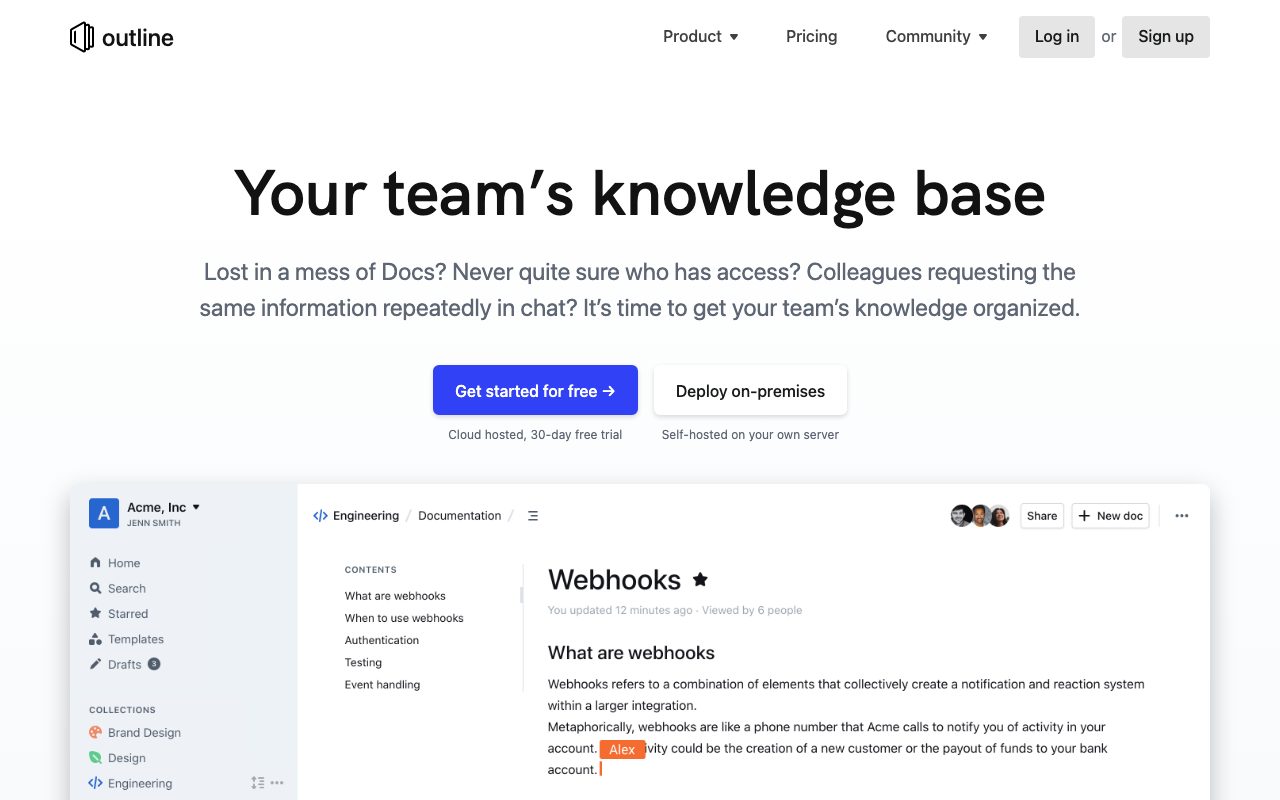
Outline is the team wiki built for the people who actually maintain the wiki. Fast, focused, block-based editor, real-time collaboration, and an open-source self-hosted option for teams that want their docs on their own infrastructure. The anti-Confluence pitch, executed well.
If you've watched a Confluence space rot or watched a Notion workspace turn into a kitchen-sink mess, Outline's restraint feels intentional. It's a wiki. It does wiki things. That's it.
For engineering teams building handbooks, runbooks, and internal docs, Outline is one of the most pleasant tools in the category. The smaller integration ecosystem and lighter feature surface are the price of that focus.
What Outline actually does
Outline organizes content into collections, which contain nested documents. The editor is block-based with markdown shortcuts. Real-time collaboration, comments, and mentions work the way you'd expect from a modern wiki.
Search is one of Outline's strongest features. Fast, accurate, full-text across all your collections. Compared to older Confluence search, the gap is night and day.
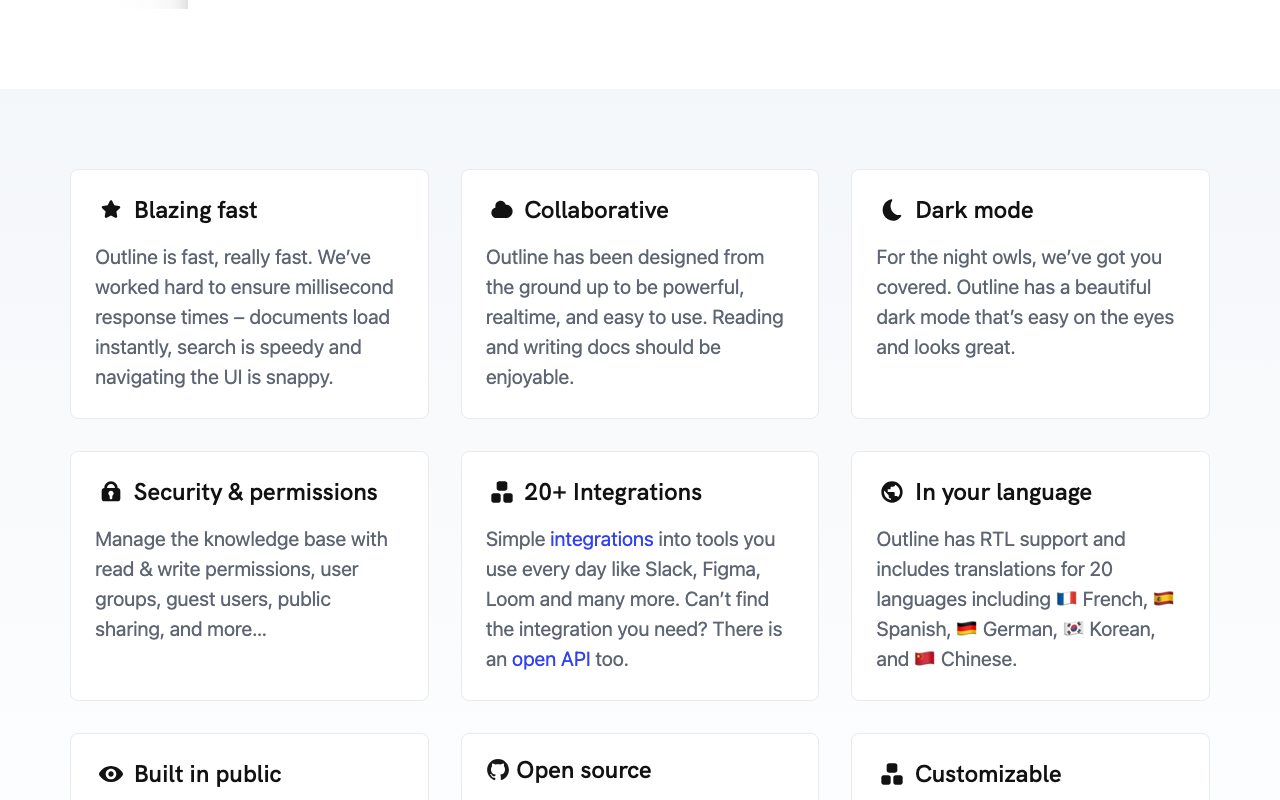
Permissions live at the collection level with overrides on individual documents. Public sharing, member sharing, and group-based access cover the common needs without the labyrinthine permission model some competitors ship.
Who Outline is for
Engineering teams building handbooks. RFCs, design docs, runbooks, postmortems. Outline's focus and editor speed make ongoing maintenance less painful.
Companies switching off Confluence or Notion. The migration story is real, the editor is more pleasant for daily writers, and the cost is lower at most team sizes.
Privacy-conscious organizations using the self-hosted open-source version. Outline ships a real OSS distribution you can run on your own infrastructure with full data control.
Customer support teams maintaining knowledge bases. Outline's clean reading view works well for both internal docs and externally shared articles.
Pricing breakdown
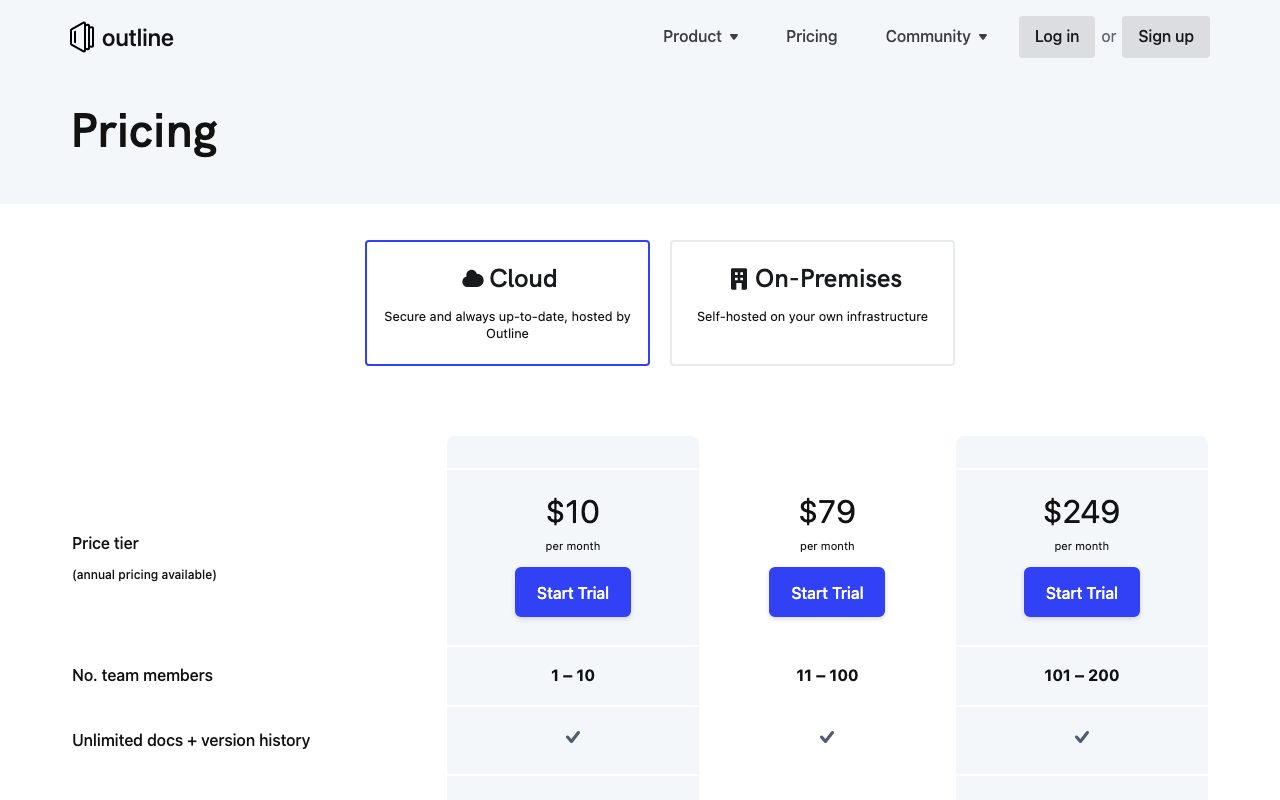
Outline's hosted SaaS starts at around $10 per user per month for the Team plan. The Business plan adds advanced permissions, audit logs, and SSO at higher tiers.
The self-hosted version is free under a BSL-style license. You provide the infrastructure, you skip the per-seat cost. For teams with ops capability, the self-hosted route saves real money at scale.
Standout features in Outline
Editor speed and polish. Outline opens fast, types responsively, and gets out of the writer's way. After a week of daily use, it's clearly more pleasant than Confluence's editor.
The permissions model is genuinely better than Notion's for teams. Group-based access, collection-level inheritance, public sharing controls. Less surprise than Notion, more flexibility than Confluence.
Self-hosted deployment is a real, supported path. Docker, Kubernetes, AWS. Ops teams with a few hours can have a production Outline running.
Markdown export
Every document exports to clean markdown. If you ever leave Outline, your content comes with you in portable form. That's a quiet but important freedom.
Honest tradeoffs
Smaller integration ecosystem than Confluence. Slack, GitHub, Linear, and a few others. If your stack is exotic, you'll write more glue.
Less flexible than database-style tools. Outline is wiki-first. If you need Notion-style databases for project tracking, Outline isn't trying to compete there.
Self-hosting requires real ops effort. Updates, backups, monitoring, scaling. Don't underestimate the maintenance load if you go that route.
Outline is the wiki for teams that want their wiki to feel light. The restraint is the feature. The smaller surface is the point.
Outline vs alternatives
Versus Notion, Outline is faster and has better team permissions. Notion has databases, more integrations, and a larger ecosystem. Different shapes. See the comparison.
Versus Confluence, Outline is dramatically more pleasant to use day-to-day. Confluence wins on enterprise breadth and Jira integration.
Versus Slite, both are focused wikis. Slite has a stronger doc-verification AI workflow. Outline has a better self-hosted story.
For more options, see the best team wikis and the Outline alternatives directory.
Bottom line
Outline is one of the most pleasant team wikis for engineering and small-to-mid-size teams. The editor speed, permissions model, and self-hosted option together carve out a real niche.
If your team treats docs as a first-class artifact, Outline rewards the investment. If you need databases, project tracking, and a kitchen-sink workspace, look at Notion instead. For pure wiki use, Outline is one of the best calls you can make.
Self-hosting Outline
The Docker compose file in Outline's repo gets you running in an evening. Add Postgres, Redis, S3-compatible storage, and an SMTP service. Outline handles the rest.
Updates are usually painless. Pull the new image, run migrations, restart. Test in staging first if you depend on it for production knowledge.
Backups are your responsibility. Postgres dumps cover the metadata; S3 lifecycle rules cover the file uploads. Without backups, a server failure costs you everything.
Outline integrations worth setting up
Slack integration shows page mentions and unfurls links. Useful for teams that talk in Slack but document in Outline.
GitHub integration links commits and PRs to relevant docs. Nice for engineering RFC workflows.
Linear integration shows ticket references inline. Project context flows between the two systems naturally.
Migrating to Outline
From Notion, the importer handles most page content. Database content rarely translates cleanly; you'll restructure it as static pages.
From Confluence, the migration is more involved. Bulk export to HTML, run a conversion script, import. Plan a few days for a meaningful Confluence migration.
From Google Docs, expect manual copying. The API access works but few teams build a custom migration tool. Doc-by-doc copy with cleanup is usually fine.
Common Outline questions
Does Outline support nested permissions? Yes, at the collection and document level. Permissions inherit from collections by default; documents can override.
Can Outline handle large knowledge bases? Tens of thousands of documents work fine. The search remains fast at scale; performance is one of Outline's strong suits.
Is the Outline API documented? Yes. The API is straightforward, well-documented, and widely used for custom integrations.
Browse more at tools for team wikis.
Outline editor patterns that work
Use markdown shortcuts. They feel faster than clicking toolbar buttons after a few hours of practice. The shortcuts mirror common markdown editors closely.
Embed Linear, GitHub, and Slack content directly when relevant. The embeds keep docs current without manual copy-paste.
Templates inside Outline reduce starting friction. Standardize meeting notes, RFC, and runbook templates; team members fill in the blanks.
Outline at scale
Hundreds of users and tens of thousands of documents work fine. Search remains fast; the editor stays responsive.
Larger deployments benefit from active curation. Stale collections, orphaned pages, and duplicate content accumulate over time.
API access enables custom workflows: automatic page creation from CI events, doc generation from code comments, or integration with other tools. The API is straightforward and well-documented.
Outline open-source contributions
The Outline open-source community is active. Bug fixes and feature contributions land regularly. If your team has the capacity, contributing back to the OSS version is a reasonable way to influence the roadmap on features you care about.
Final thoughts on Outline
Outline is the wiki for teams that want their wiki to feel light. The editor speed, permissions model, and self-hosted option together carve out a real and defensible niche.
It's not a workspace replacement. It's a wiki, deliberately. Teams that want databases, project boards, and a kitchen-sink workspace should look at Notion. Teams that want a great wiki should put Outline at the top of the list.
Browse other options at the best internal documentation tools and knowledge management tools.
Quick recap
Outline fits engineering teams, mid-size companies switching off Confluence or Notion, and privacy-conscious orgs that value the self-hosted option. The editor speed and permissions model are the standout reasons to switch.
It's not a workspace replacement. Outline is a wiki, deliberately. Teams needing databases or kanban should look at Notion instead.
Hosted SaaS or self-hosted open source. Pick based on your ops capacity. Both paths produce the same product experience.
Browse more options at the best docs tools, the team docs category, and Outline alternatives.
Outline community
The maintainers are responsive, the GitHub repo is active, and the community contributes meaningful improvements. For a wiki tool, that ecosystem health matters.
Outline closing notes
The product keeps a focused identity in a category prone to feature bloat. That restraint is what makes it pleasant to use day after day.
If your team writes more than it reads, Outline rewards the daily writers. The editor speed alone shifts how often people open the wiki to update something.
Versus the wider competitive set, Outline lands in a defensible niche between Notion's flexibility and Confluence's enterprise weight. That niche is exactly right for many engineering and product organizations.
Browse more wiki options at the best markdown editors and the broader tools for writing category.
Tutorial / Demo
Key Features
- Block-based collaborative editor
- Nested collections for team wikis
- Real-time editing and comments
- Strong search across all content
- Slack, GitHub and Linear integrations
- Self-hosted open-source option
Pros & Cons
What we like
- Fast and uncluttered
- Open source variant available
- Better permissions model than Notion for teams
- Markdown export keeps content portable
Room for improvement
- Less flexible than a database tool
- Smaller integration ecosystem than Confluence
- Self-hosting requires real ops effort
Frequently Asked Questions
Is Outline free?
Outline vs Notion, which?
Can I self-host Outline?
Does Outline integrate with Slack?
Can I import from Notion or Confluence?
Best For
Featured in
Tags
Alternatives to Outline

Bear
A beautiful Markdown notes app for Apple devices that doubles as a writing tool

Confluence
Atlassian's long-running team wiki that anchors many enterprise knowledge stacks

Slite
A focused team wiki that uses AI to keep your knowledge base actually trustworthy
Capacities
A studio for your mind built on objects rather than pages
Our take
Tool Index Editorial · May 2026· 4.5/5
If you're evaluating Outline, the headline is simple: a team wiki that feels lightweight enough to actually keep up to date, and most teams will get value out of the box.
Worth highlighting: Fast and uncluttered, Open source variant available, and Better permissions model than Notion for teams. The friction points: Less flexible than a database tool and Smaller integration ecosystem than Confluence.
Bottom line: pick Outline when you need engineering team handbooks; look elsewhere if less flexible than a database tool would be a dealbreaker.
Editorial opinion from the Tool Index team, written from the public product pages. Not a user review.
Reviews (2)
Recommended without reservation
Hadn't planned on switching, but Outline was hard to ignore. Real selling point: fast and uncluttered.
Solid daily driver
Have been using Outline for a while, here's where I land. The biggest win has been open source variant available. One thing that bugs me: less flexible than a database tool. Would buy again without thinking twice.
Cons
- Smaller integration ecosystem than Confluence
Badge builder
Add Outline to your website
Choose a badge style and size, preview it here, then copy the generated HTML. Badge images are self-contained SVGs and do not require an external script.

<a href="https://toolindex.net/tools/outline?ref=badge" target="_blank" rel="noopener">
  <img src="https://toolindex.net/badge/outline/medium.svg" alt="Outline - Listed on Tool Index" width="180" height="50" />
</a>How to use the badge
- 1. Pick the style, size, and theme that fit your layout.
- 2. Copy the generated HTML from the code block.
- 3. Paste it into your footer, homepage, or press page.
Standard badge available
The standard listing badge is available now. Score and circle badges are limited to tools currently ranked in the top 10 of a category.
Badge clicks return visitors to this profile with a referral tag so the source remains identifiable.
Related Tools
Confluence
Atlassian's long-running team wiki that anchors many enterprise knowledge stacks
Asana
Project management for teams that live in projects, tasks and dependencies
Kevin Gabeci Toolkits
Seven AI toolkits for writing books, making music, cutting video, and building agents.

SoloDevStack
A solo developer blog built on head-to-head tool comparisons, 580+ posts deep.
Work on Outline? Request listing access or correction