
WorldFixture
An open-source fake company with emulated Slack, GitHub, mail, Stripe and S3 for local testing
Gallery
About WorldFixture
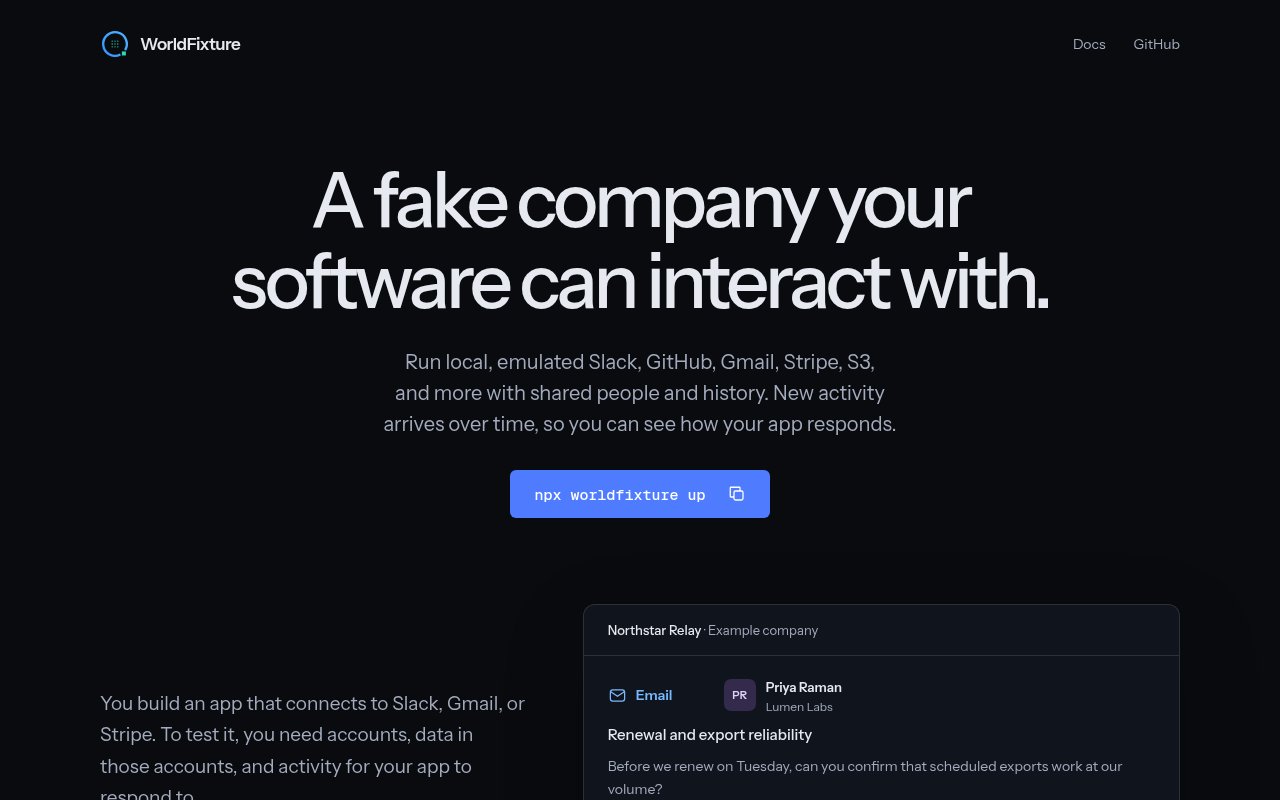
WorldFixture is an open-source tool that runs a fake company on your machine so the software you're building has something realistic to talk to. It stands up local, stateful emulations of Slack, GitHub, Gmail style mail, Stripe, S3, Google, Notion and more, all sharing one synthetic dataset of people, messages, repositories, documents and billing records. Your app points at the local endpoints instead of the real services, and it behaves as if a small company were on the other end.
The problem it solves is familiar to anyone who has built integrations. Testing against the real Slack or Stripe means real accounts, sandboxes, credentials and rate limits, and it means the data on the other side is either empty or someone else's mess. Mocks are the other extreme, so thin that a demo falls apart the moment someone clicks somewhere unexpected. WorldFixture sits in between with a coherent world where the same fictional employees show up in the chat history, the commit log and the invoices.
Getting it running is a single command, npx worldfixture up, with a flag to start only the services you need, and npx worldfixture open brings up the Workbench interface. It needs Docker and Node 22 or later on an arm64 or amd64 machine. Every emulated domain lives under the .worldfixture.test suffix, ports are assigned for each run, and the whole world is resettable, so a broken test state costs you a restart rather than an afternoon. Under the hood it builds on emulate.dev, Cyrus IMAP, SeaweedFS and SQLite.
The worlds themselves are pre-built. The project maintains a collection of synthetic companies, each with its own people, organisation, domains, message history and financial records, and one shared dataset runs across every emulated service at once, so the person who opened a GitHub issue is the same person who posted in the Slack channel and appears on the invoice in Stripe. Mail is handled by a local mail service with SMTP, so the flows where your app sends a notification and expects a reply can be exercised end to end without an email ever leaving the machine.
The detail that makes it more than a set of stubs is time. New activity arrives over time through the local provider APIs, so scheduled messages, emails, GitHub comments, payments and S3 objects keep landing while your software runs. The Workbench lets you control that clock, pause and resume the world, and loop a scenario so you can replay the same sequence of events while you debug. That's the difference between checking that a webhook parses and watching your product cope with a week of company life in a few minutes.
It's built for developers writing software that integrates with these services, and it's pitched at three moments in particular. Local development, where you want realistic data without touching production. Demos, where you need a believable company on screen and no risk of messaging a real person. And CI, where a deterministic, resettable world beats flaky calls to third-party sandboxes. The project is explicit that it never contacts real systems or people.
The repository holds the runtime and Workbench UI alongside the emulators, compiler tools, examples, documentation and test suites, and at the time of writing it shows 55 stars and just over a hundred commits, which is to say a real project with a small following. A first session looks like this. Run the up command, open the Workbench, point your app's Slack or GitHub configuration at the local ports it reports, and watch activity start to arrive. When something goes wrong you reset the world and try again.
Where it differs from recording and replaying real API traffic is that the world is generated and coherent rather than captured. There's a catch that the docs are upfront about. Each emulator implements selected provider API operations, not the full surface of every service, so the API support index is the first thing to check before you rely on a specific endpoint. It isn't a contract test against the real provider either, so a green run here doesn't prove the live API hasn't changed under you. It's also a young project, with a small community and a shorter track record than the mocking libraries most teams already know.
Access is open source under the Apache 2.0 licence, with the code, documentation, examples and emulators on GitHub. There's no paid tier and nothing to sign up for. You install it, run it locally, and point your software at the fake company.
Key Features
- Local emulated Slack, GitHub, mail, Stripe and S3
- One shared synthetic company dataset
- Simulated activity that arrives over time
- Workbench to pause, resume and loop scenarios
- Resettable world for repeatable CI runs
- Single npx command startup on Docker
Pros & Cons
What we like
- Realistic integration testing without real accounts or credentials
- Coherent data across services, not disconnected stubs
- Time control makes multi-step workflows testable
- Apache 2.0 licensed with no paid tier
Room for improvement
- Only selected API operations per provider are implemented
- Needs Docker and Node 22 or later
- Young project with a small community
- Emulated behaviour can drift from the real services
Frequently Asked Questions
What is WorldFixture?
Is WorldFixture free?
Does it cover every API of each service?
How is it different from mocking?
Best For
Featured in
Alternatives to WorldFixture

Playwright
Microsofts open-source end-to-end browser testing framework for Chromium, Firefox, and WebKit with one API.

Selenium Boot
Java testing framework that brings Spring Boot conventions and Playwright APIs to Selenium

Buildkite
Hybrid CI/CD where the control plane is hosted but the build agents run on your own infrastructure.

Storybook
Open-source workshop for building UI components in isolation. Preview, document, and test them outside the app.
Reviews (0)
Badge builder
Add WorldFixture to your website
Choose a badge style and size, preview it here, then copy the generated HTML. Badge images are self-contained SVGs and do not require an external script.

<a href="https://toolindex.net/tools/worldfixture?ref=badge" target="_blank" rel="noopener">
  <img src="https://toolindex.net/badge/worldfixture/medium.svg" alt="WorldFixture - Listed on Tool Index" width="180" height="50" />
</a>How to use the badge
- 1. Pick the style, size, and theme that fit your layout.
- 2. Copy the generated HTML from the code block.
- 3. Paste it into your footer, homepage, or press page.
Standard badge available
The standard listing badge is available now. Score and circle badges are limited to tools currently ranked in the top 10 of a category.
Badge clicks return visitors to this profile with a referral tag so the source remains identifiable.
Related Tools

DeviceKit
Free Screen & Device Tests Online | Private Browser Diagnostics

Chromatic
Visual regression testing and review platform built by the Storybook team, with cloud-rendered snapshots and PR integration.
Playwright
Microsofts open-source end-to-end browser testing framework for Chromium, Firefox, and WebKit with one API.

Tests.ws
WebSocket testing tools, protocol guides, and a Chrome extension for developers
Work on WorldFixture? Request listing access or correction